


Summary:
“Can online Muslim marriage coaching truly save your relationship? Discover what research reveals about virtual sessions, privacy concerns, and why 70% of couples report equal or better results compared to in-person counseling.”
Your Honest Doubts About Virtual Counseling
You’re ready to get help with your marriage. But the idea of discussing intimate problems over Zoom feels wrong. Can someone really understand what’s happening between you and your spouse through a screen?
You’re wondering: Will they miss the tension in the room? Can you talk about sensitive topics on video? Is this even appropriate in Islam?
Your skepticism is normal. Most Muslim couples felt the same way until recently. But something changed during the pandemic. When therapists moved online out of necessity, researchers discovered something unexpected.
Virtual marriage counseling works just as well as in-person therapy. Success rates for both formats sit at 70-75%. For many couples, online coaching actually produces better results because of privacy, convenience, and consistency.
This guide addresses every doubt you have about online Muslim marriage coaching.
Coaching vs. Counseling: What’s the Difference?
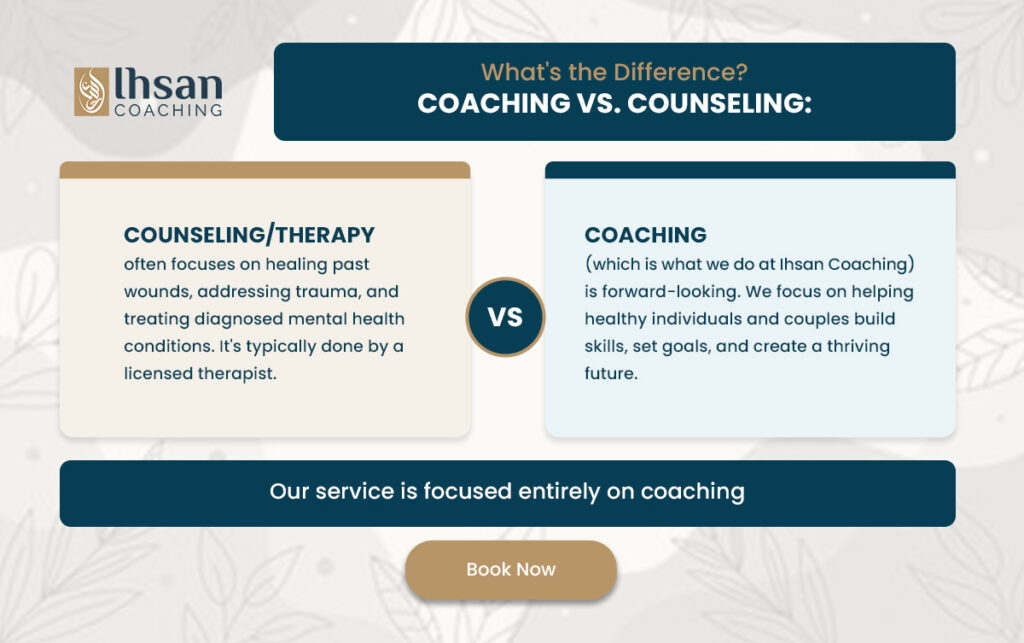
Note: Our services at Ihsan Coaching are only focused entirely on coaching.
What Actually Happens in Online Marriage Coaching
The Real Success Rate
Research on telehealth marriage counseling reveals clear findings:
70-75% of couples report significant improvement after completing online programs.
No meaningful difference in outcomes between video and in-person sessions for common marital issues.
Higher program completion rates online couples are 20-30% more likely to finish their full program.
Translation: Online Muslim marriage counseling works for communication problems, recurring conflicts, in-law issues, spiritual disconnection, and intimacy concerns the issues most couples face.
Learn how online Islamic marriage coaching works in practical terms.
What Works Best Online
Virtual sessions excel at:
- Teaching communication skills and active listening
- Premarital preparation for engaged couples
- Addressing family boundary and in-law conflicts
- Rebuilding spiritual connection as a couple
- Developing co-parenting strategies
When You Need In-Person Help
Consider in-person for:
- Severe mental health crises (suicidal thoughts, severe clinical depression)
- Active substance abuse
- Physical safety concerns or domestic violence
- No reliable internet or private space access
Internal Link: Understand marriage coaching vs therapy to determine what level of support you need.
Is Online Counseling Halal? The Islamic Perspective
This is the first question many Muslim couples ask.
The Clear Answer: Yes.
Islam has no prohibition against using technology for marriage help. The Quran explicitly encourages seeking arbitration when couples struggle:
The method of arbitration whether face-to-face, by letter, or by video is not specified in Islamic texts. What matters is your sincere intention to reconcile and preserve your marriage according to Allah’s guidance.
Contemporary Islamic scholars agree: Online counseling is permissible and even encouraged when it removes barriers to getting help while maintaining Islamic etiquette.
See professional standards in the role of a Muslim therapist.
Gender and Modesty Concerns
Your concern: You don’t feel comfortable discussing intimate matters with an opposite-gender coach, even online.
The solution online provides: When you’re limited to local coaches, you might have 2-3 options. Online access opens up hundreds of qualified Muslim coaches globally, making it simple to find same-gender coaches who match your needs.
Professional Muslim coaches maintain:
- Appropriate lowering of gaze during video sessions
- Professional boundaries around sensitive topics
- Respect for cultural and religious sensitivities
- Gender-matched team options when needed
Your Privacy is Protected
Your fear: “What if someone hacks our session? What if my family discovers we’re getting help?”
The technical reality:
HIPAA-compliant platforms provide:
- End-to-end encryption (only you and coach access content)
- No recording without your explicit consent
- Encrypted database storage with password protection
- Two-factor authentication for account security
Bonus privacy benefits online:
- No one sees you entering a counseling office
- No risk of community members in waiting rooms
- You control your physical environment completely
- No paper appointment cards or local trails
Discover why Muslims trust Ihsan Coaching for confidential services.
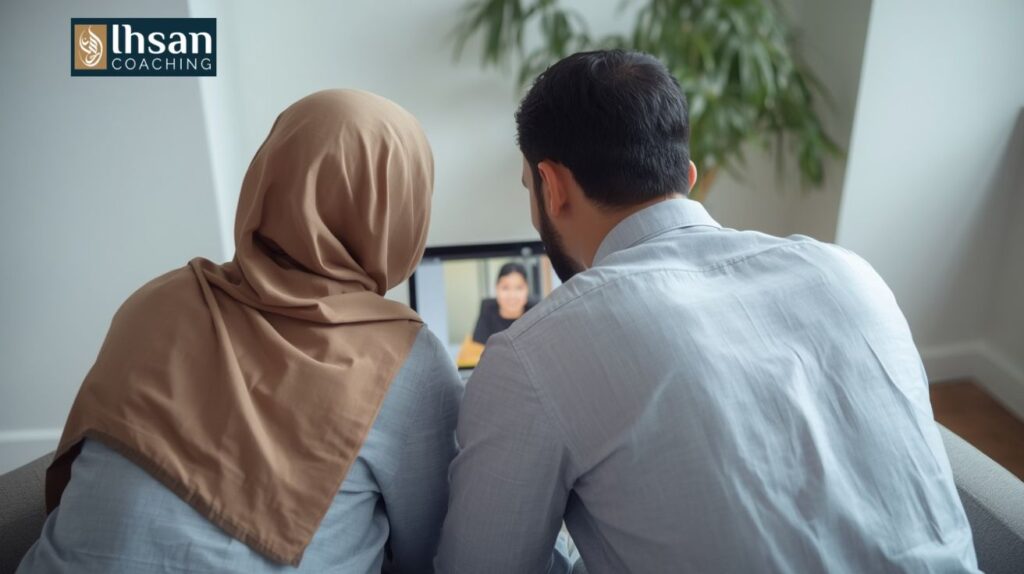
Why Online Coaching Often Works Better
You Can Access the Right Specialist
Old problem: You live in a small town. The only local option is a non-Muslim counselor who doesn’t understand Islamic family dynamics, halal/haram boundaries, or cultural expectations.
New solution: Work with specialized Muslim coaches anywhere in the world. A couple in rural areas can access Toronto experts. London couples can work with California specialists in second marriages or interracial relationships.
It Actually Fits Your Life
Time comparison:
In-person session: 2-2.5 hours total (30 min travel each way, parking, 60-min session)
Online session: 60 minutes total (log in from living room, 60-min session)
For working parents with young children, this difference matters. It’s the gap between “impossible to schedule” and “we can make this work.”
Couples Actually Complete the Program
Online programs have 20-30% higher completion rates. Why?
- No cancelled sessions due to weather or traffic
- Lower barrier when you’re exhausted no driving required
- Easier to maintain weekly rhythm without logistics
- Less temptation to skip when “it’s been a hard week”
Why completion matters: Consistency is the #1 predictor of counseling success. Couples completing 8-12 consecutive sessions see dramatically better outcomes than those attending sporadically.
Address ongoing marriage conflict through consistent work.
The Surprising Comfort Factor
Many couples report being more honest in online sessions than in traditional offices.
Why: Your own home feels safe rather than clinical. The slight physical distance through the screen creates psychological safety for discussing deeply personal topics. You have tissues nearby, can sit in your favorite chair, and take bathroom breaks in your own space if emotions run high.
Addressing Your Specific Concerns
“Won’t They Miss Important Body Language?”
What coaches see clearly online:
- Facial expressions in HD video
- Tone of voice without office distractions
- How you position yourself relative to your spouse
- Who speaks first, who interrupts, who shuts down
- Micro expressions showing contempt, defensiveness, or stonewalling
What they might miss: Subtle hand gestures or full body shifts.
What research shows: Verbal patterns, facial expressions, and tone all clearly visible online are what actually matters for outcomes. The subtle physical cues rarely change results.
“It Will Feel Weird and Impersonal”
What actually happens: Most couples report any awkwardness disappears within 10-15 minutes of the first session. By session two, it feels completely natural.
Why: You’re making eye contact with the camera. The coach’s full attention is on you without office distractions. Many people feel more authentic without the pressure of sharing physical space.
“What If the Internet Cuts Out?”
Professional coaches have backup plans:
- Immediate switch to phone call if video fails
- Session extended for significant interruptions
- Penalty-free rescheduling for major technical problems
You can prevent most issues:
- Close other applications during your session
- Connect via ethernet cable instead of WiFi when possible
- Keep your phone nearby as backup device
When Online Coaching Might Not Work
Be honest about these situations:
- Severe technology anxiety that becomes a major distraction (though most adapt within one session)
- No private space in a crowded household where family can overhear
- Active safety concerns where you need a neutral, safe location for sessions
- Constantly unstable internet with no alternative access points
- Strong personal preference for face-to-face interaction (that’s valid choose what works)
If joint sessions aren’t feasible, explore individual coaching services as an alternative.
How to Make Online Sessions Work
Set Up Your Environment
- Private room with door you can close
- Good lighting (face a window or use desk lamp)
- Camera at eye level (stack books under laptop if needed)
- Both partners visible in frame for couples work
Eliminate Distractions
- Put phones on silent or airplane mode
- Close all browser tabs
- Tell family you’re unavailable for 75 minutes
- Turn off computer notifications
Engage Completely
Treat online sessions as seriously as in-person:
- No multitasking (no email, cooking, or laundry)
- Take notes if it helps you remember
- Complete homework between sessions
- Be as honest as you would face-to-face
Your effort determines your results format doesn’t.
Prepare effectively with 12 questions to ask during premarital coaching.
The Clear Answer: Does It Work?
Yes, when specific conditions are met.
Online coaching succeeds when:
✅ Both partners commit and attend consistently
✅ You have reliable internet and technology
✅ You create a distraction-free private space
✅ You engage as seriously as in-person sessions
✅ You practice new skills between sessions
Online coaching struggles when:
❌ Severe crises need immediate clinical intervention
❌ Safety concerns exist in the relationship
❌ Partners refuse honest engagement
❌ Technology anxiety becomes a barrier
The evidence is clear: For 70-80% of Muslim couples, online coaching is equally effective as in-person counseling and often more convenient, private, and accessible.
The format matters far less than the coach’s quality, your commitment level, and your consistency.
Take Your Next Step
Your marriage deserves the best help available. Don’t let technology concerns prevent you from getting it.
Do this now:
- Honestly assess if you meet the conditions for successful online coaching
- Research qualified Muslim coaches with telehealth experience
- Book a free consultation to test the technology and see if you connect with the coach
- Commit to at least 6-8 sessions before deciding if it’s working
Book an appointment today and discover how online coaching can transform your marriage from your own home.
Your Questions Answered
Is online really as effective as in-person?
Yes. Research consistently shows 70-75% effectiveness for both formats. Success depends on coach skill and your commitment, not the delivery method.
Can coaches truly read body language through video?
Yes. HD video clearly shows facial expressions, tone changes, and interaction patterns the critical elements for couples work.
Is virtual counseling halal?
Yes. The Quran encourages arbitration for marital conflict (4:35). The method of arbitration isn’t specified in Islamic texts.
What happens if our internet fails during a session?
Your coach immediately switches to phone call, extends session time if needed, or reschedules without penalty for major technical issues.
Is online counseling truly private and secure?
Yes. HIPAA-compliant platforms use end-to-end encryption. Online is often more private than in-person because no one sees you entering an office.
How do I decide between online and in-person?
Choose online for convenience, privacy, and access to specialists. Choose in-person for active safety concerns, severe clinical issues, or strong personal preference.
Disclaimer: The Quranic verses and Hadith referenced in this article are cited for educational and spiritual reflection purposes. Translation sources used: [e.g. Sahih International, Sunnah.com]. This content is not intended as a fatwa or religious ruling.