


Modern dating culture is confusing, overwhelming, and often compromises core Islamic values. Because dating in Islam requires a completely different approach than Western dating, many single Muslims struggle to navigate the “talking stage” without crossing lines.
While casual dating isn’t permitted, getting to know a potential spouse (Ta’aruf) is highly encouraged. By establishing clear Islamic boundaries, you can evaluate a potential partner without compromising your faith or your emotional well-being.
Here is exactly how to navigate the modern search for a spouse while honoring the non-negotiable boundaries of Islam.
Can Muslims Date? (Is Dating Haram in Islam?)
If you are asking, “Can Muslims date?” or “Is dating haram in Islam?”, the answer depends entirely on your definition of dating.
Yes, the Western concept of casual dating is considered a haram relationship. It is typically defined by a lack of commitment, physical intimacy before marriage, and secrecy from families. Islam strictly prohibits this because it opens the door to heartbreak, emotional dependency, and major sins.
However, relationships in Islam intended purely for marriage (Halal Courtship or Ta’aruf) are completely permissible and highly encouraged. Islam does not expect you to marry a stranger. You are encouraged to speak, assess compatibility, and ask deep questions provided you follow strict Islamic dating rules.
7 Essential Muslim Dating Rules & Boundaries
Whether you are navigating matrimonial apps or getting to know someone from your community, these are the 7 rules of dating in Islam that you must establish from day one.
1. Marriage Must Be the Only Intention
In Islam, any interaction with a non-mahram (someone you can legally marry) must have a specific, purposeful intention. If you aren’t financially, emotionally, or spiritually ready to get married in the next 6 to 12 months, you should not be entering the talking stage.
Casual “talking stages” or dating just for companionship inevitably lead to haram territory. Your intention must explicitly be to evaluate the person for marriage.
2. Eliminate ‘Khalwa’ (Private Seclusion)
Khalwa refers to a man and a woman being alone together in a private space where they cannot be easily seen or interrupted. The Prophet Muhammad (ﷺ) warned that when a non-mahram man and woman are secluded, Shaytan (the devil) is the third presence.
How to navigate this:
- Never sit in a parked car alone together.
- Do not hang out in private apartments or empty offices.
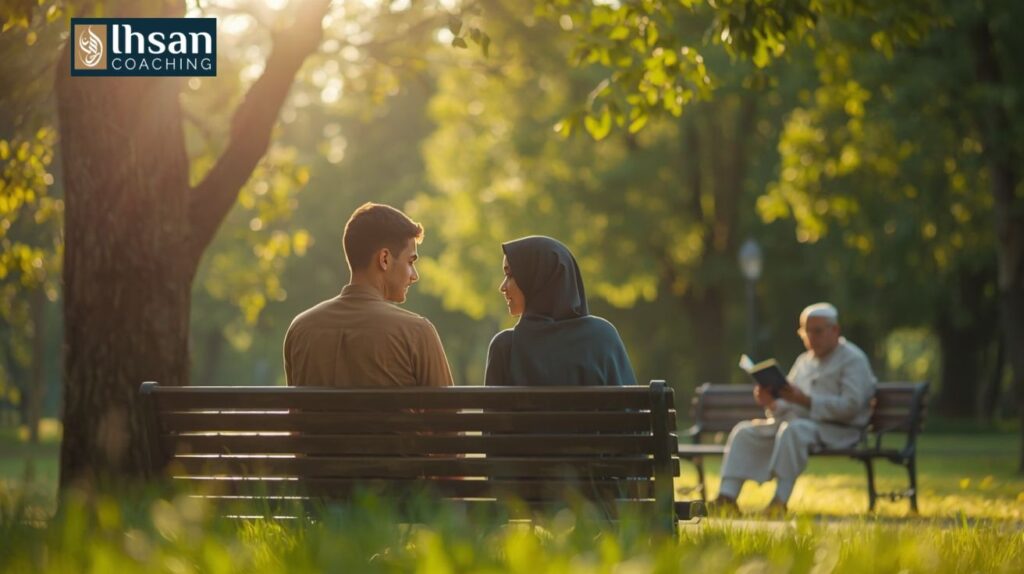
- Halal Alternatives: Meet in well-lit coffee shops, public parks, or at home with family members present in the next room.
3. Establish Absolute Physical Boundaries
When it comes to Islam dating rules, there is no gray area regarding physical touch. There is zero physical contact allowed before the Nikah (Islamic marriage contract) is signed.
This means no holding hands, no hugging, and no “innocent” touching. Physical touch releases bonding hormones like oxytocin, which clouds judgment and expedites emotional attachment before true intellectual or spiritual compatibility is established.
4. Involve Families Early On
Western culture normalizes hiding relationships from parents until things get “serious.” Islamic dating rules flip this dynamic completely.
To protect both parties (especially the woman), Islam requires the involvement of a Wali (guardian). Involving parents early provides a safety net, accountability, and a layer of wisdom that is critical when you are looking through rose-colored glasses. Keeping a relationship secret is one of the biggest red flags in an Islamic courtship.
5. Maintain Digital Modesty (Texting & Calls)
In the modern age, Khalwa isn’t just physical; it’s digital. Emotional affairs are easily built over late-night texting. To maintain digital modesty:
- Avoid late-night phone calls or texting when you are vulnerable or tired.
- Do not exchange suggestive photos.
- Keep communication purposeful rather than sending endless “good morning” or “what are you doing?” check-ins.
6. Keep Conversations Goal-Oriented
If you are dating a Muslim, whether you are born Muslim, a convert, or exploring the faith, your conversations should be a strategic interview for marriage.
What to discuss:
- Religious practice and values (prayer, fasting, hijab).
- Financial expectations and career goals.
- Conflict resolution and family dynamics.
- Absolute deal-breakers.
Avoid excessive flirting, romanticizing the future before a commitment is made, or deep emotional “trauma dumping.” Save the deep emotional intimacy for after the marriage contract is signed.
7. Set a Strict Timeline
Indefinite talking stages breed temptation and anxiety. You cannot truly know everything about a person until you live with them.
Set a clear timeline typically 3 to 6 months to make a final decision. If you cannot comfortably say “yes” to marrying them after a few months of purposeful conversation, it is time to politely walk away.
What Defines a Haram Relationship in Islam?
If you are currently talking to someone and are unsure if you are crossing boundaries, look out for the red flags of a haram relationship:
- Secrecy: The relationship is hidden from your parents or Wali.
- Physical Touch: Boundaries are constantly being pushed or rationalized.
- No Timeline: The person enjoys your attention but refuses to set a date for the Nikah or involve their family.
- Distraction from Deen: The relationship is making you miss prayers, lower your Islamic standards, or feel spiritually disconnected.
If your relationship involves any of these, it is time to take a step back, establish boundaries, and reassess your intentions.
Navigating Relationships in Islam (Next Steps)
Navigating these rules in dating can be difficult, especially if emotions and attachments are already involved. It is entirely normal to feel overwhelmed when trying to balance natural human attraction with strict Islamic boundaries.
If you are in the talking stage and need help assessing your compatibility safely, Ihsan Coaching is here to help. Our faith-sensitive professionals provide a neutral, Islamic framework to guide your courtship safely to the Nikah.
Ready to evaluate your compatibility the Halal way? 👉 Book a Premarital Coaching Session with Ihsan Coaching today.
For a deeper dive into specific scenarios, managing emotions, and the complete matrimonial process, read our Complete Guide to Halal Dating for Western Muslims.