

Are you exhausted from endlessly balancing family obligations, career goals, and your Deen, yet still feeling like the “perfect Muslimah” is always out of reach? This relentless, invisible pressure leads many to experience deep muslim women burnout, a state where even your daily prayers feel like a heavy burden. Too often, the cultural response to this exhaustion is to “just have Sabr,” leaving women to suffer silently without a lifeline. But true Sabr is not about passive endurance; it is about actively seeking healing and setting boundaries. If you are struggling to find the “sweetness of faith” amidst severe spiritual and emotional depletion, this guide merges modern psychological strategies with Islamic theology to help you recover.
What Does Muslim Women Burnout Actually Look Like?
Burnout is not just feeling tired after a long day; it is a state of chronic physical, emotional, and spiritual depletion. For Muslim women, this burnout often sits at the intersection of clinical exhaustion and spiritual disconnect. The pressure to balance Deen and Dunya excelling at work, managing a household, nurturing children, and maintaining a pristine spiritual life creates an unsustainable load of invisible labor.
The Data Behind the Exhaustion
The reality of this burden is backed by science. According to the American Psychological Association (APA), women consistently report higher levels of chronic stress and burnout compared to men, primarily due to disproportionate emotional and domestic labor [1]. When we contextualize this within the Muslim community, cultural expectations often magnify the load.
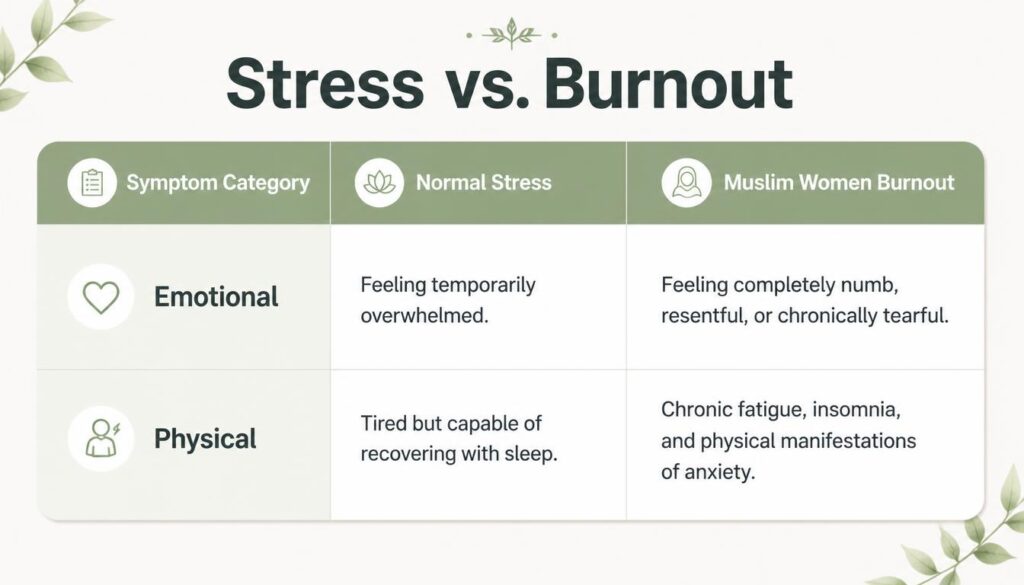
A visual breakdown of how this manifest can help distinguish between normal stress and burnout:
“When spiritual burnout hits, the first casualty is often the connection to Allah worship transitions from a sanctuary of peace into just another item on an endless to-do list,” explains a therapist at Ihsan Coaching who specializes in Individual Coaching.
Why “Just Have Sabr” Can Sometimes Be Harmful Advice
In many of our cultures, the immediate prescription for any form of distress is Sabr (patience). While Sabr is a beautiful and foundational Islamic concept, its cultural misuse has turned it into a weapon to enforce endurance without boundaries. Telling a woman on the verge of a breakdown to “just have Sabr” often translates to: Suffer in silence and don’t complain.
This is a dangerous misinterpretation of Islamic theology. True Sabr is active, not passive. The Prophet Muhammad ﷺ did not just passively endure hardship; he actively sought refuge in Allah from anxiety and sorrow (Hamm and Hazn), he set boundaries, and he rested.
“O Allah, I seek refuge in You from anxiety and sorrow, weakness and laziness, miserliness and cowardice, the burden of debts and from being overpowered by men.” (Sahih al-Bukhari 2893)
When we tell women to just endure toxic environments or unsustainable workloads under the guise of Sabr, we trap them in a guilt cycle. They begin to feel guilty for being tired, and guilty for not being able to focus in their prayers, which only deepens their spiritual depletion. True Sabr means recognizing your human limits, trusting Allah (Tawakkul), and actively seeking the help and changes you need to survive.

When Did Rest Become a Weakness Instead of a Sunnah?
Somewhere along the line, the modern “hustle culture” merged with cultural expectations to convince us that resting is a sign of laziness or a weak faith. But in Islam, rest is a form of worship when it is done with the intention of reviving your body and soul to better serve Allah.
Taking a step back requires immense Tawakkul the trust that the world, your career, and your household will not collapse if you take an hour, a day, or a weekend to yourself. The Prophet ﷺ reminded us that our bodies have rights over us:
“Your body has a right over you, your eyes have a right over you, and your wife has a right over you.” (Sahih al-Bukhari 5199)
Resting is a Sunnah. It is a protective measure for your mental health. Filling your own cup isn’t selfish; it is a divine requirement so that you have the capacity to show up for your Deen and your family.
How Can You Heal from Spiritual and Emotional Exhaustion?
Healing from burnout requires a holistic approach that honors both your biology and your theology. Here is a practical roadmap to help you find your footing.
- Prioritize the Fard, Pause the Nafl
When you are burnt out, the thought of waking up for Tahajjud or reading a Juz of the Quran a day might induce panic. That is okay. Islam is a religion of ease. During seasons of severe depletion, give yourself the grace to scale back. Focus purely on your Fard (obligatory) acts, like your five daily prayers, even if you struggle with focus (Khushu). Pause the Nafl (voluntary) worship without guilt. Consistency in the obligatory acts is more beloved to Allah than burning out entirely.
- Practice Compassionate Self-Talk and Honest Dua
Soften your inner dialogue. We are often our own harshest critics, demanding perfection where Allah only asks for effort. Replace harsh self-criticism with the same mercy Allah shows His creation. Make raw, honest Dua. You do not need perfect Arabic to speak to Allah. Simply saying, “Ya Allah, I am exhausted, I am empty, and I need Your help to heal,” is a profound act of worship.
- Embrace Practical Self-Care
Your mental clarity is directly tied to your physical health. Prioritize sleep, movement, and nutrition. Even Islamic practices like the Sunnah of fasting can be integrated as a way to build mental clarity and self-discipline, provided you are nourishing yourself properly at Suhoor and Iftar.
- Build Boundaries and Seek Support
Untangle your personal identity from constant productivity. Learn to say “no” to commitments that drain your limited energy. More importantly, lean on your community and consider professional support. If navigating relationship challenges is adding to your burnout, Marital Coaching or speaking to a professional can help you establish healthy boundaries at home.
Why Seeking Professional Help is a Sign of Strong Faith
There is a persistent stigma that seeking therapy means your faith isn’t strong enough. This couldn’t be further from the truth. Burnout is a physiological and emotional limit being reached; it is not a theological failure.
Seeking professional help is the ultimate application of the Prophet’s ﷺ advice to “tie your camel and trust in Allah.” Acknowledging that you need support requires courage and deep self-awareness.
Engaging with culturally competent therapists who understand the nuances of your faith, such as experts offering Religious Consultation and coaching at Ihsan Coaching ensures that your healing aligns with your values.
Final Thoughts: A Gentle Nudge to Return
Experiencing muslim women burnout does not make you a bad Muslim; it makes you human. Your exhaustion is valid, and Allah’s mercy is vast enough to encompass your burnout. Healing is not a linear journey, and you do not have to walk it alone.
If you are feeling overwhelmed, emotionally numb, or spiritually distant, it might be time to seek a structured, faith-based path to recovery. Let us help you untangle the stress. Book an appointment today with Ihsan Coaching for a 15-minute consultation and take the first step towards feeling like yourself again.
References
- [1] American Psychological Association (APA). (2023). Stress in America: A National Mental Health Crisis.
- [2] Sahih al-Bukhari 2893. (Supplication for anxiety and sorrow).
- [3] Sahih al-Bukhari 5199. (The rights of the body).