

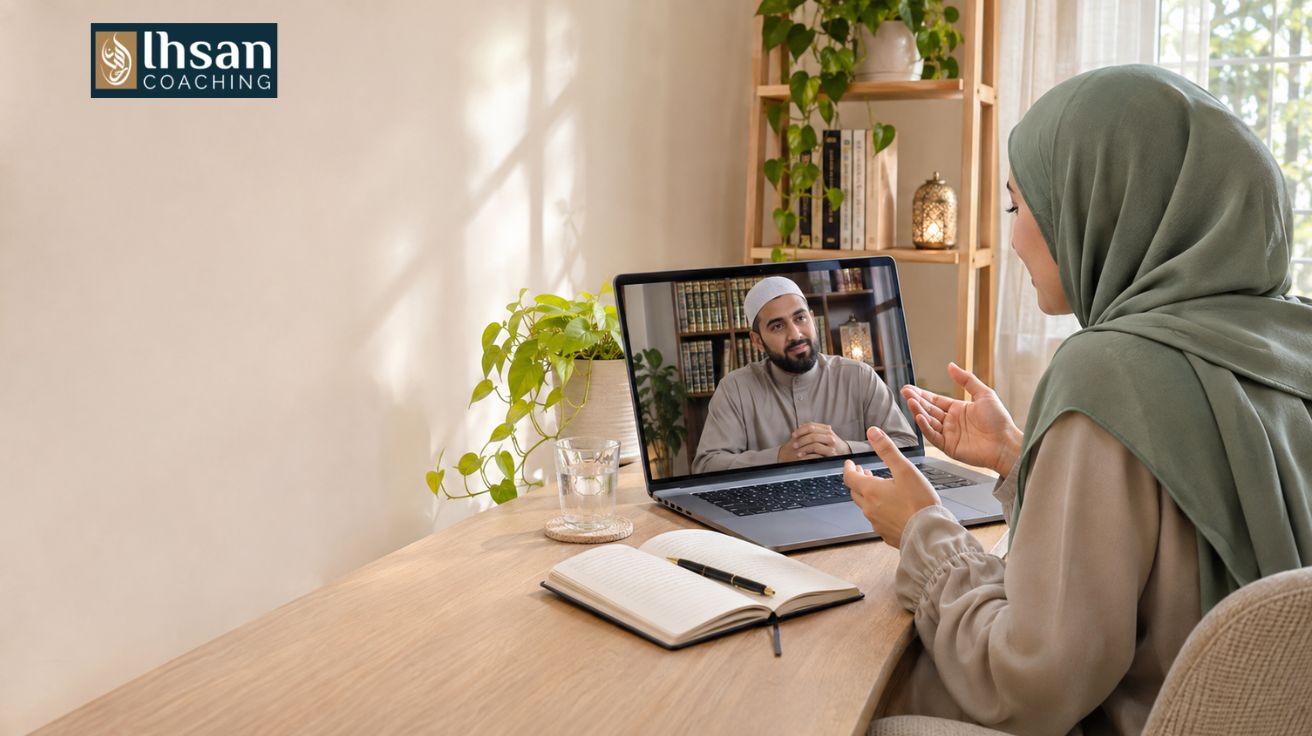
Summary:
An online Islamic religious consultation typically runs 45 to 60 minutes over video and follows the same structure as an in-person meeting: your consultant listens to your specific situation, grounds the guidance in the Quran and Sunnah, and sends you away with something concrete to act on, not just a conversation. A 2023 systematic review pooling over twenty clinical trials found video sessions produce therapeutic relationships and outcomes comparable to in-person ones, and for many people, meeting from home feels more private than being seen walking into a local mosque or office. Come with a general sense of what’s on your mind, a quiet space, and your honest situation. This is not a formal fatwa service or clinical treatment, and a consultant worth their time will tell you plainly if your question belongs somewhere else.
What Actually Happens Before Your First Call?
Booking a religious consultation online is probably the vaguest step in the whole process. You know roughly why you’re reaching out. You don’t know what actually happens after you click the link, and that small uncertainty is often enough to make people put it off for another month.
After booking, expect a short form asking what brings you in, a few lines, not a lengthy intake. It’s not a screening test. It just gives your consultant enough to work with so the call itself isn’t spent on background you could have written down in two minutes.
What Does the Session Itself Actually Look Like?
Most sessions move through four stages, in roughly this order.
- The opening: a short, informal start, usually beginning with salaam and a quick word on how the session will run before you get into your situation.
- Discussing your situation: this is most of the call. You talk, your consultant asks clarifying questions, and nobody rushes to a verdict before understanding what’s actually going on.
- Where the guidance comes from: grounded in the Quran, Sunnah, and established scholarship, applied to your actual situation rather than delivered as a general khutbah.
- Leaving with something concrete: a session that ends well gives you a clear next step, not just a conversation that felt good for forty minutes and left you exactly where you started.
Does Meeting Online Actually Work as Well as Meeting in Person?
A 2023 systematic review and meta-analysis in JMIR Mental Health pooled results from more than twenty randomized clinical trials and compared telehealth video sessions with in-person treatment across therapeutic alliance, treatment outcomes, patient satisfaction, and dropout rates. It found no statistically significant difference between the two formats on any of those measures. Read the full review. That review looked at clinical therapy rather than religious consultation specifically, so it supports the format itself, video versus in-person, rather than proving an identical result for every kind of guidance. What changes online is how the conversation is delivered. What doesn’t change is whether the guidance holds up.
How Does an Online Consultation Actually Compare to Meeting in Person?
Online vs. In-Person Islamic Religious Consultation
| Feature | In Person Consultation | Online Consultation |
| Location | A set office, mosque, or community space you travel to. | Your own home or any quiet private space with a stable connection. |
| Privacy | You may be seen entering or leaving, which can raise questions in a close knit community. | A video call from home blends into a normal day with far less visibility. |
| Scheduling | Limited to times that suit both travel and office hours. | Often more flexible, including evenings, weekends, or different time zones. |
| Technology Needed | None. | A phone, tablet, or computer with a camera, and a link sent ahead of time. |
| What Stays the Same | Structured conversation, guidance grounded in Quran and Sunnah, a clear next step. | Structured conversation, guidance grounded in Quran and Sunnah, a clear next step. |
What Technology Do You Actually Need?
Just a phone, tablet, or computer with a camera and a stable connection. A link is sent ahead of your scheduled time, and there’s usually no account or software to set up beyond clicking it when the session starts.
Is Getting Religious Consultation Online Actually More Private Than Meeting Locally?
For a lot of people, yes. Being seen walking into a local mosque or community center for something personal can itself raise questions in a close-knit community, regardless of what the consultation is actually about. A video call from home blends into an ordinary day with far less visibility, which matters more than people expect, right up until they’re the one who needs it.
If privacy or scheduling has been the thing holding you back, that’s exactly what this format solves. Book a consultation and see how it actually runs before you decide anything further.
When Should You Look for a Different Resource Instead?
A religious consultation is built around your specific, ongoing situation. It is not a formal fatwa on a complex point of fiqh, and it is not clinical treatment for a diagnosed mental health condition. If either of those is what you actually need, a consultant worth trusting will say so directly and point you to a qualified scholar or a licensed mental health professional, rather than stretching to cover ground outside their role.
What Should You Prepare Before the Call?
- A general sense of the situation or question, even if it isn’t fully organized yet.
- A quiet, private space where you can speak honestly without being overheard.
- A willingness to describe what’s actually going on, not a polished, pre-edited version of it.
- A charged device and a connection tested a few minutes before the session starts.
How Does Intention Shape a Consultation?
The opening hadith of Sahih al-Bukhari, Hadith 1, narrated by Umar ibn al-Khattab, teaches that actions are judged by their intentions. It doesn’t mention consultations specifically, but it’s a real foundation for taking a moment before the call to set a sincere intention for it.
A consultation approached with genuine openness tends to go somewhere real. One approached purely out of obligation, or to prove a point to someone else, usually doesn’t, no matter how sound the guidance on the other end is.
Why Choose Ihsan Coaching for Online Religious Consultation?
Our religious consultation is delivered online by design, so you can meet from home on a schedule that fits your life, with the privacy that format allows. If the format itself has been the thing holding you back, that’s the easiest part of this to resolve.
Frequently Asked Questions
How long does a typical session last?
Most sessions run 45 to 60 minutes, though this can vary depending on what you’re working through.
Can I remain anonymous or use a different name?
Ask directly during booking. Many consultants can accommodate a first name only, or another level of anonymity that helps you speak openly.
What if I don’t know exactly what I want to ask?
Completely normal. A good first session can help you put into words the actual question underneath a general sense that something needs attention.
Can my spouse or family join the call with me?
Often yes, depending on what’s being discussed. Mention it when booking so the session can be structured for that.
What happens after the session ends?
You leave with a specific next step, whether that’s something to reflect on, a practice to start, or a reason to book a follow-up if the situation needs more than one conversation.