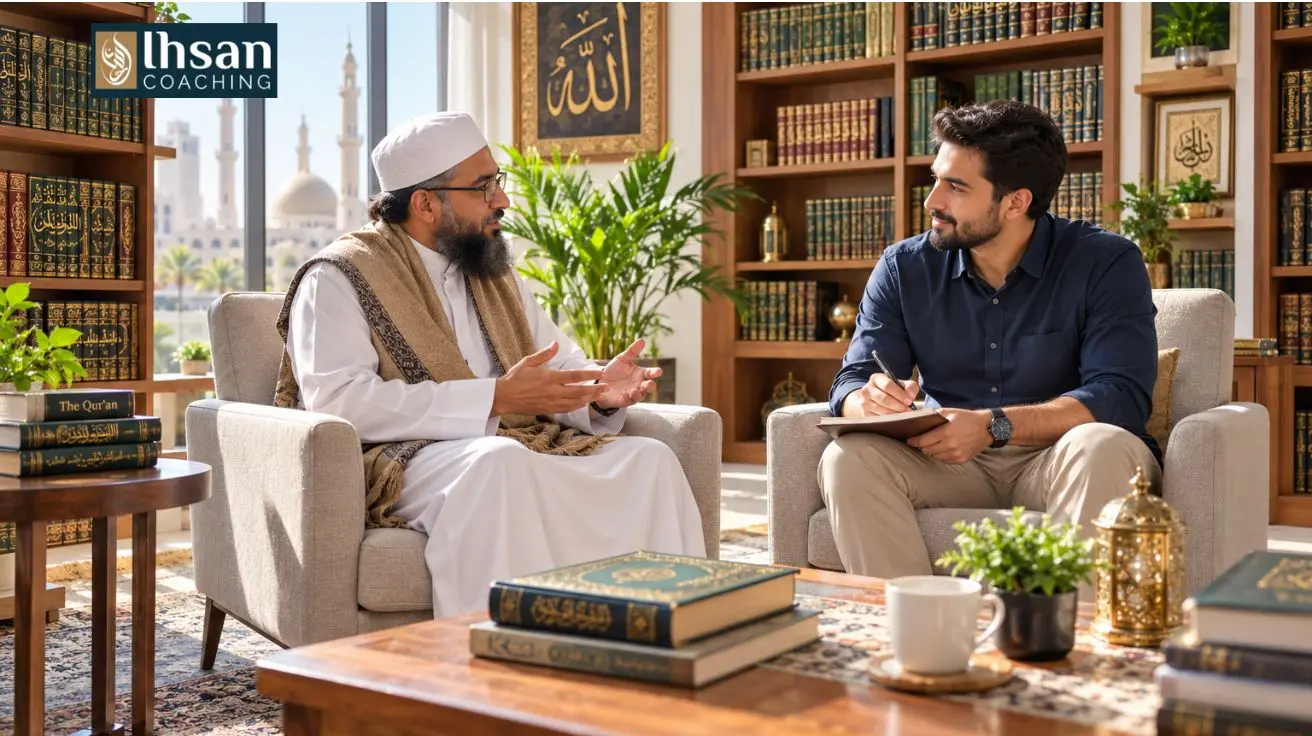
Summary:
Religious consultation focuses on Islamic theology and jurisprudence to provide specific rulings (Fatwas) on what is halal or haram. Individual coaching is a structured, future-focused process that helps you build habits, overcome mental blocks, and reach personal goals using psychological tools aligned with Islamic values. Choose consultation for legal answers. Choose coaching for behavioral change.
Why Do Muslims Confuse Life Coaching With Religious Consultation?
The confusion stems from historical roles in the Muslim community. For generations the local Imam served as the primary resource for every problem. If someone had a marital dispute, financial trouble, or a crisis of faith, they went to the Imam.
Today the American Muslim community faces complex modern challenges like career burnout and nuanced mental health struggles. These require specialized frameworks. Imams still provide vital pastoral care. However, the demand for structured and solution-focused interventions has created a specific need for faith-based life coaching. Knowing the difference ensures you get the exact help you need.
What Exactly Is Religious Consultation in Islam?
Religious consultation means seeking guidance strictly on matters of faith, theology, and Islamic jurisprudence. You are asking a qualified scholar for a direct ruling on a specific situation to ensure your actions align with Islamic law.
When you seek traditional religious consultation, the goal is theological alignment. A scholar provides the legal boundaries for your life. As classical scholars emphasized, it is a duty to seek knowledge from qualified sources when you do not know the answer.
How Does Individual Coaching Differ from Traditional Consultation?
A religious scholar tells you the rules. A coach helps you build the skills and habits to live productively within those rules.
| Feature | Religious Consultation | Individual Coaching |
| Primary Focus | Islamic law, theology, rulings | Behavioral change, habit building, goal setting |
| Approach | Directive (Scholar gives the answer) | Non-directive (Coach uses guided inquiry) |
| Structure | Often a one-off Q&A session | Ongoing weekly or bi-weekly structured sessions |
| Ultimate Goal | Theological clarity and alignment | Holistic growth and emotional regulation |
Individual coaching uses a client-centered approach. A coach holds you accountable over time to make sure you achieve the behavioral changes you want.
When Should You Seek Religious Consultation?
You must consult a qualified religious scholar or Imam when your primary need is theological clarity.
- You have specific questions about acts of worship like fasting, prayer, or purification.
- You need to verify if complex financial contracts are Shariah-compliant.
- You need to calculate Zakat or divide an estate according to Islamic inheritance laws.
- You require a formal ruling on divorce proceedings according to Islamic law.
- You struggle with deep theological doubts and need intellectual answers about faith.
When Do You Need Individual Coaching?
You need a certified coach when you understand the Islamic rules but struggle to implement them or overcome mental roadblocks.
- You feel stuck in your career: You want to navigate burnout and find your purpose.
- You lack daily motivation: You know you should pray regularly but struggle to build the discipline.
- You need better relationship skills: You are dealing with premarital anxiety and want premarital coaching to build strong communication frameworks.
- Your marriage needs a reset: You want structured marital coaching to break toxic cycles and rebuild emotional intimacy.
- You feel overwhelmed by life: You want a solution-focused approach to manage your time and regulate your emotions.
How Can You Integrate Both for Holistic Well-Being?
Holistic well-being often requires both approaches working together. The Islamic concept of mutual consultation encompasses seeking both spiritual and practical advice.
You do not have to choose one over the other. A religious scholar provides the compass. An individual coach provides the vehicle. You can seek a fatwa regarding a difficult divorce, and then work with a coach to rebuild your self-esteem and navigate the emotional aftermath. Recent trends show that faith-integrated psychological interventions are highly effective for the American Muslim community.
Why Choose Ihsan Coaching for Your Journey?
Ihsan Coaching balances traditional Islamic values with modern psychological tools. We do not issue fatwas. Our entire coaching framework relies on proven behavioral strategies rooted in Islamic principles.
If you want to overcome personal roadblocks, improve your marriage, or align your daily habits with your goals, our comprehensive services are designed for Muslims ready for real change. Stop letting confusion hold you back. Book an appointment today to build a roadmap for your success.
Frequently Asked Questions
Can an Imam also be a life coach?
Yes. Some Imams pursue dual credentials and become certified life coaches. However, you should always clarify whether a session will be a theological consultation or a structured coaching session before you begin.
Do I need coaching or therapy?
Coaching focuses on the present and the future to help you achieve specific goals. Therapy focuses on healing past traumas and treating diagnosed mental health conditions. Many clients work with both a therapist and a coach simultaneously.
Is Islamic life coaching permissible?
Yes. Seeking practical advice, building good habits, and improving your mental well-being are highly encouraged in Islam. Coaching simply provides a structured method to achieve personal excellence.