

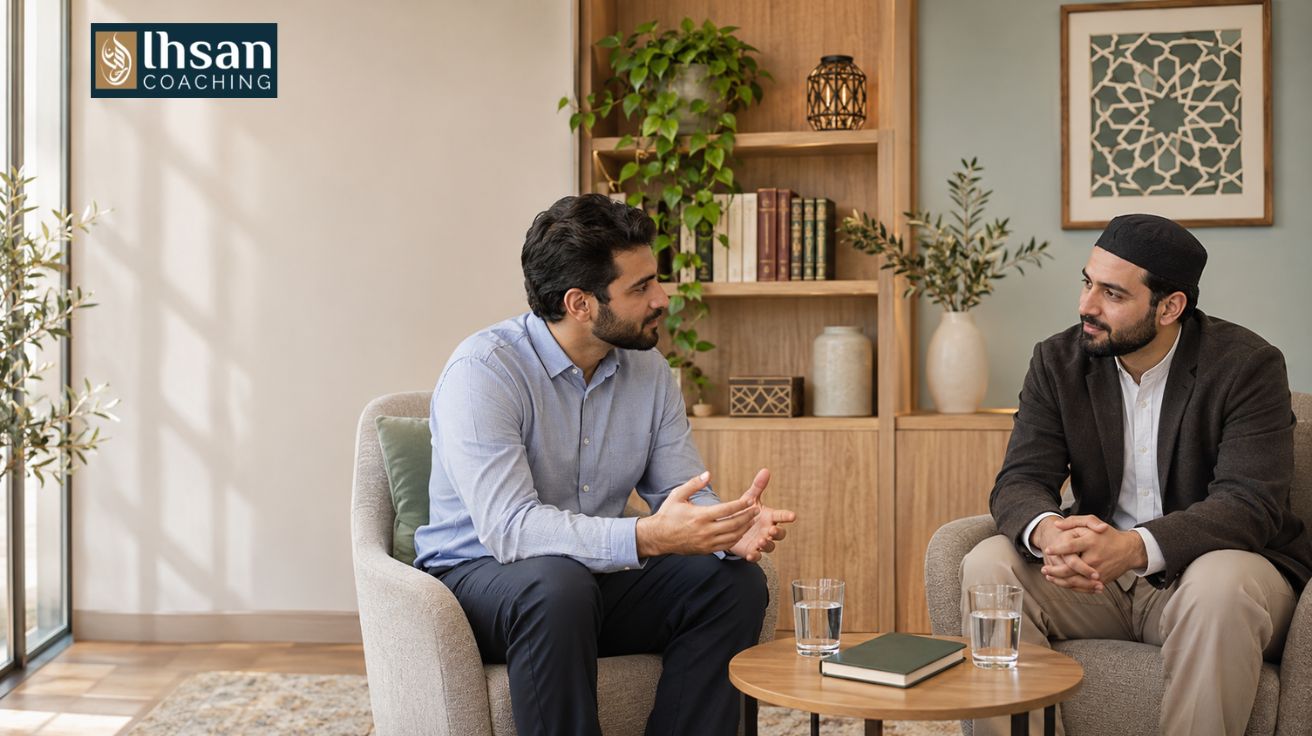
Summary:
An imam or sheikh is the right resource for a question of Islamic ruling or deeper religious knowledge. A religious consultant is the right resource for working through a specific ongoing situation, such as a marriage, a major decision, or persistent stress, in a way that integrates faith. A licensed therapist or psychiatrist is the right resource for a diagnosable mental health condition, such as clinical depression, trauma, or anything involving risk to someone’s safety. Match the resource to the type of problem, and remember that using more than one at the same time is common and often the most complete path.
Imam vs Religious Consultation vs Therapy: Why Do So Many People Turn to the Wrong Kind of Help First?
When something is genuinely wrong, in a marriage, in your own mind, or in your sense of what Allah wants from you right now, choosing between an Imam vs Religious Consultation vs Therapy can be confusing. Most people default to whoever they already know, not necessarily whoever is qualified for that specific problem. That instinct is understandable, and it is also the reason many people spend months with the wrong kind of help before finding the right one.
Research on Muslim help-seeking, including studies published in Pastoral Psychology and indexed in PubMed Central, describes religious leaders as a common first point of contact during psychological distress, often before any mental health professional is consulted. The same body of research notes that most imams have little to no formal mental health training, so turning to a trusted religious figure first does not always connect someone with the kind of help a clinical situation requires.
What Does an Imam Actually Do?
An imam’s core role is leading the community in prayer and often delivering the khutbah, alongside a broader pastoral presence: officiating marriages, offering general religious guidance, and being a visible, trusted figure in day to day community life.
Training varies widely from one imam to another. Some have extensive formal study in fiqh and hadith. Others are deeply respected community figures without the same depth of specialized scholarly training. Both are valuable roles, but they are not interchangeable with specialized expertise in every area someone might need help with.
What Does a Sheikh Add That an Imam Might Not?
The title sheikh generally signals a deeper, more formal level of Islamic scholarship, often including a recognized chain of study and specialization in areas like fiqh, hadith, or aqeedah. For a nuanced or complex question of Islamic ruling, a qualified sheikh is typically the more appropriate person to ask than a general community imam.
What Does a Religious Consultant or Coach Actually Do?
A religious consultant works differently from either role above. Rather than issuing rulings or leading worship, a consultant works with you over multiple sessions on one specific, ongoing situation, applying Islamic principles to real, practical decisions rather than answering a single theological question.
This is not a clinical service, and a religious consultant is not aiming to diagnose or treat a mental health condition. It sits in a middle space: more structured and ongoing than a single conversation with an imam, and more faith integrated than secular coaching or therapy typically offers.
How Do the Three Resources Compare?
The table below summarizes where each resource fits.
| Feature | Imam or Sheikh | Religious Consultant | Licensed Therapist |
| Core Role | Leads worship and gives religious guidance, with a sheikh typically holding deeper scholarly training. | Works with you over multiple sessions on one ongoing personal situation, applying Islamic principles. | Assesses and treats mental health conditions using clinical training. |
| Best Suited For | Questions of Islamic ruling, worship, and religious knowledge. | A marriage, a major decision, grief, or a recurring personal struggle. | Clinical depression, trauma, panic symptoms, or anything affecting safety. |
| Not Designed For | Ongoing structured work on a personal situation, or clinical treatment. | Issuing fiqh rulings or treating diagnosed conditions. | Issuing religious rulings. |
| Typical Format | A single conversation or short exchange. | Multiple scheduled sessions with follow up. | Regular scheduled sessions over time. |
When Does a Situation Actually Need a Licensed Mental Health Professional?
A licensed professional is the right first call when you notice any of the following.
- Persistent sadness, hopelessness, or loss of interest in daily life that has lasted for weeks, not days.
- Difficulty functioning in basic daily responsibilities, such as work, prayer, or caring for family.
- Symptoms connected to a specific trauma, including flashbacks, nightmares, or being unable to stop reliving an event.
- Noticeable mood swings, panic symptoms, or substance use that is affecting the household around you.
- Any thoughts of self harm, which call for urgent professional or emergency help right away, not reliance on any of these three resources alone.
Can You Use More Than One of These at the Same Time?
Yes, and this is common. A person working with a licensed therapist on clinical depression might still consult a sheikh about a specific question regarding their worship obligations during that period. A couple working with a religious consultant on their marriage might also have one partner seeing a therapist individually for something unrelated to the relationship. These roles are not competing with each other. They answer different questions.
How Can You Decide Who to Call First?
- If your question is what Islam says about something: start with an imam for a general question, or a sheikh directly for something nuanced or high stakes.
- If you are working through a specific, ongoing personal situation: a religious consultant is built for exactly this, whether it is a marriage, a major decision, or a recurring struggle.
- If what you are feeling has lasted weeks and is affecting daily life: start with a licensed mental health professional, ideally one who understands and respects Islamic values.
How Does the Quran Guide Us to the Right Source of Help?
The Quran instructs believers in Surah An-Nahl (16:43) to ask the people of knowledge if they do not know. Although the verse was revealed in a specific context concerning the messengers who came before Prophet Muhammad (peace be upon him), scholars have drawn from it a broader principle: seeking answers from those who possess the relevant knowledge.
While the verse does not directly address mental health or coaching, this principle offers a meaningful Islamic foundation for choosing guidance according to the nature of the problem and the expertise required to address it.
From this perspective, seeking help from a qualified mental health professional for a clinical condition does not mean turning away from faith. Rather, it can be understood as applying the principle of consulting people with relevant knowledge to a field that requires specialized training and expertise.
Why Choose Ihsan Coaching for Religious Consultation?
Ihsan Coaching’s religious consultation sits in the religious consultant role described above. It is not a substitute for a scholar’s ruling on a fiqh question, and it is not a substitute for licensed clinical treatment when a situation calls for one. Where a different resource is the better fit, you will be told directly. If you are not sure which resource fits your situation, book your appointment and we will help you think through the right starting point, even if that ends up being somewhere other than coaching.
Frequently Asked Questions
Can a religious consultant give a fatwa or fiqh ruling?
No. A religious consultant works on applying faith to an ongoing personal situation, not issuing religious rulings. A specific fiqh question belongs with a qualified imam or sheikh.
Is it wrong to see a therapist instead of an imam?
No. For a clinical mental health condition, a licensed therapist is the appropriate resource, and seeking that kind of specialized help is consistent with the Islamic principle of consulting people with the relevant knowledge.
What if my imam doesn’t have mental health training and I still need help?
Many imams will say this themselves and refer you onward. If yours does not, you can still seek a licensed mental health professional directly, ideally one who understands Islamic values, without needing your imam’s referral first.
Can I bring up a sensitive personal issue with a sheikh?
Yes, for the religious dimension of the issue. For the ongoing, practical work of resolving it, a religious consultant or a licensed professional, depending on what the issue is, is typically better equipped for that part.