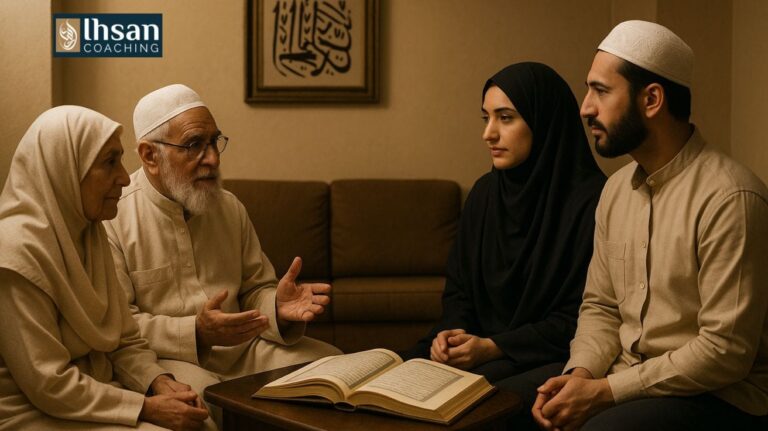


Something has changed in your spouse, and you cannot quite name it. They are quieter than they used to be. A little more distant. Small things set them off in ways that never used to happen. You catch yourself wondering: is this a marriage problem, or is this something else?
It is a fair question, and the honest answer is that it can be both. Depression in a spouse does not arrive with a label attached. It shows up looking like distance, irritability, or silence and it is easy to mistake for disrespect or a marriage going cold.
This guide is written for you, the spouse standing next to someone who is struggling. It walks through how to recognize what is actually happening, what Islam asks of you in this season, and how to support your partner without quietly losing yourself in the process.
Recognizing Depression in Your Spouse vs. Normal Sadness
Everyone has hard days. Depression is something different. The National Institute of Mental Health (NIMH) defines it as a common but serious mood disorder that causes severe symptoms affecting how you feel, think, and handle daily activities. To be diagnosed, these symptoms must be present for at least two weeks. It’s not a passing rough patch that lifts on its own after a good night’s sleep or a better week at work.
Watch for changes that stick around rather than pass:
- Sleep Disturbances: Suddenly sleeping too much (hypersomnia) or too little (insomnia).
- Appetite and Weight Changes: A noticeable shift in appetite, leading to significant weight loss or gain.
- Persistent Fatigue: A tiredness that doesn’t improve with rest, the kind that feels heavier than ordinary exhaustion.
- Anhedonia: This is the clinical term for a loss of interest or pleasure in activities they once enjoyed prayer circles, family visits, hobbies that used to bring them genuine pleasure.
- Cognitive Difficulties: Trouble concentrating, remembering details, or making decisions. They might seem to drift mid-sentence or lose track of simple things.
- Irritability: In many people, especially men, depression manifests not as sadness but as increased frustration, anger, or a short temper.
Here is something worth knowing: depression in a spouse rarely looks like visible sadness. In many Muslim households, it shows up as irritability, silence, or withdrawal and gets misread as coldness, disrespect, or a marriage simply growing distant. It is neither. It is what depression often looks like from the outside, especially in cultures where openly naming sadness does not come easily.
This guide will help you notice the pattern. It is not a diagnostic tool, and you are not meant to diagnose your spouse. If what you are seeing matches this picture, the next right step is encouraging a real evaluation from a qualified professional, not guessing at labels yourselves.

What Islam Says About Supporting a Struggling Spouse
Marriage in Islam was never described as a partnership only for the easy seasons. Allah says in the Qur’an: “And of His signs is that He created for you from yourselves mates that you may find tranquility in them; and He placed between you affection and mercy (mawaddah wa rahmah).” (Surah Ar-Rum, 30:21). That mercy, Rahmah, is not conditional on your spouse being at their best. It is most needed exactly when they are not.
The Prophet Muhammad (ﷺ) modeled this directly. His standard of character was measured by one’s conduct at home. He said: “The best of you are those who are best to their wives, and I am the best of you to my wives.” (Sunan Ibn Majah, No. 1977). That standard does not pause during hard seasons. If anything, it is tested most clearly there.
It helps to reframe what Sabr actually means here. Patience is not passive suffering through a difficult marriage. It is active, compassionate steadiness. As a concept, Dr. Rania Awaad of the Stanford Muslim Mental Health & Islamic Psychology Lab often emphasizes that Islamic tradition frames emotional hardship not as a failure, but as a test that, when borne with patience, becomes a means of purification and drawing closer to Allah. Your steadiness has real spiritual weight. It is not just something you are enduring. It is something you are doing.
How Depression Affects Islamic Duties — A Compassionate Perspective
This part is sensitive, and it deserves honesty. A depressed spouse may pray less. They may seem distant during Ramadan, during family gatherings, during moments that used to matter visibly to them. Acts of worship that once felt automatic can start to feel impossible.
Here is what it does not mean: it is not a sign of weak Iman, and it is not deliberate negligence. Islamic jurisprudence has always shown compassion toward illness affecting worship. A sick person is not held to the same standard as a healthy one in matters of prayer and fasting. Scholars have long recognized that the heart and mind, like the body, can fall genuinely ill.
Research Insight: In a paper on mental health, the Yaqeen Institute for Islamic Research notes that such trials are not indicators of divine punishment but are opportunities for spiritual growth and reliance on Allah’s mercy. The internal struggle with motivation is part of the illness itself.
Be careful here with one well-meaning but harmful instinct: using religious guilt as a corrective tool. Telling a depressed spouse to “pray more” or “think about your akhirah” rarely helps and often makes things worse. It adds shame on top of an illness that already carries plenty of it. Depression responds to compassion and proper care, not pressure dressed up as religious advice. The Prophet (ﷺ) himself experienced a period of profound grief after the deaths of his wife Khadijah (RA) and his uncle Abu Talib, a time known as the ‘Am al-Huzn (Year of Sorrow). The tradition does not treat that sorrow as a flaw in his character. It treats it as part of being human. Your spouse’s struggle deserves that same dignity.
Things That Help vs. Things That Hurt
Some responses genuinely help. Others, said with the best intentions, quietly make things harder. Knowing the difference matters more than almost anything else.
Communication That Heals vs. Communication That Harms
| What Helps (Things to Say & Do) | What Hurts (Things to Avoid) |
|---|---|
| “I’m here for you, even if we just sit in silence.” (Offering presence without pressure) | “Just snap out of it. Other people have it worse.” (Minimizing and comparing) |
| “What would feel most supportive to you right now?” (Asking for their need) | “You just need to have more sabr / make more dua.” (Using religious principles as a dismissal) |
| “I’ve noticed things have been tough lately. I love you, and we’ll get through this together.” (Validating their struggle & affirming your commitment) | “You’re not even trying. You used to be so much more [fun/engaged].” (Accusing and blaming) |
| “Let’s look into some options for professional support together. I’ll be with you every step.” (Framing help as a team effort) | Quietly taking over all their responsibilities, leading to your resentment and their loss of agency. |
Protecting Your Own Mental Health While Being a Caregiver
This is the part almost no one talks about, and it deserves real attention. Supporting a spouse through depression is a form of caregiving. And caregiving has a real, well-documented cost.
Authoritative Research: According to the Centers for Disease Control and Prevention (CDC), caregivers of adults with health problems or disabilities are at a higher risk for poor mental and physical health. A comprehensive review published in JAMA Internal Medicine found that approximately 1 in 3 caregivers of adults experience psychological distress, including depression and anxiety.
Translate that directly to your situation: if you are exhausted, withdrawn, or quietly resentful after months of carrying more than your share, that is not a personal failure or a lack of love. It is caregiver burnout, a well-documented phenomenon.
A few boundaries protect you without taking anything away from your spouse:
- Keep your own worship steady. Your salah and dhikr are not selfish; they are what sustain you.
- Stay connected. Do not withdraw alongside your spouse. Maintain your connections to friends, family, or community, even when it feels easier to disappear together.
- Seek support for yourself. A coach, a counselor, or a trusted confidant is wisdom, not selfishness.
Islam never asked one spouse to dissolve themselves in service of the other. Two whole people are what sustain a marriage, not one person quietly disappearing into it.
When to Suggest Professional Coaching or Counseling — and How to Do It
Raising this can feel delicate. The right framing turns it into an invitation.
Expert Quote: Renowned relationship researchers at The Gottman Institute have found that couples who navigate conflict and stress as a “we” against the problem, rather than a “me” versus “you,” have significantly more stable and satisfying marriages.
Adopt this “we” framework. Try language like this: “I love us, and I want us to figure this out together. Would you be open to talking to someone with me?” That single shift, from “you need help” to “let’s do this together,” changes everything.
Couples coaching is particularly valuable because depression rarely stays contained to one person; it affects the relationship dynamic. Individual therapy for the depressed spouse is also crucial, and often the two work best in tandem.
If you want to understand what your spouse may be experiencing more directly, our guide on how spiritual guidance helps Muslims dealing with depression offers insight from their side. And if the emotional distance has been building, our piece on emotional disconnection in marriage is worth reading.
You Have Not Failed Your Marriage or Your Faith
Go back to where this started the disorientation of watching someone you love change in front of you.
It was something deeper than just a marital rough patch. And that is not a verdict on your relationship or your faith. It is a season, one that asks for real tools, honest compassion, and the willingness to protect your own wellbeing. You are allowed to need support too. That is not a contradiction of caring for your spouse. It is what makes caring for them sustainable.
If this season has stretched on longer than you can carry alone, our guide on navigating therapy for depression and anxiety is a good next step for your spouse, for you, or for both of you together.