
Summary:
These five Quranic duas offer Muslim women words for seeking guidance, goodness, mercy, protection from wrongdoing, and righteous children. Each prayer includes an English explanation, its Quranic reference, and its original context. These supplications are not exclusive to women, and none guarantees a particular outcome. They can accompany practical support, informed decisions, and appropriate professional care.
You do not need to have everything under control before turning to Allah. You may be facing an important decision, feeling overwhelmed by responsibilities, hoping for a child, or simply looking for words that express what is on your heart.
Dua is personal supplication: asking Allah for help, mercy, guidance, and good. Your concerns do not have to fit a particular life stage before you can bring them into prayer.
This guide brings together five Quranic duas for women, with explanations that respect both the original passages and the different circumstances women experience.
The English meanings below are paraphrases for understanding, not word-for-word translations. The source links provide the original Quranic text and published translations.
Which Quranic Duas Can Muslim Women Read?
Choose a prayer by its meaning rather than assuming that every situation requires a special formula.
| What You Want to Ask For | Quranic Reference | Original Context |
|---|---|---|
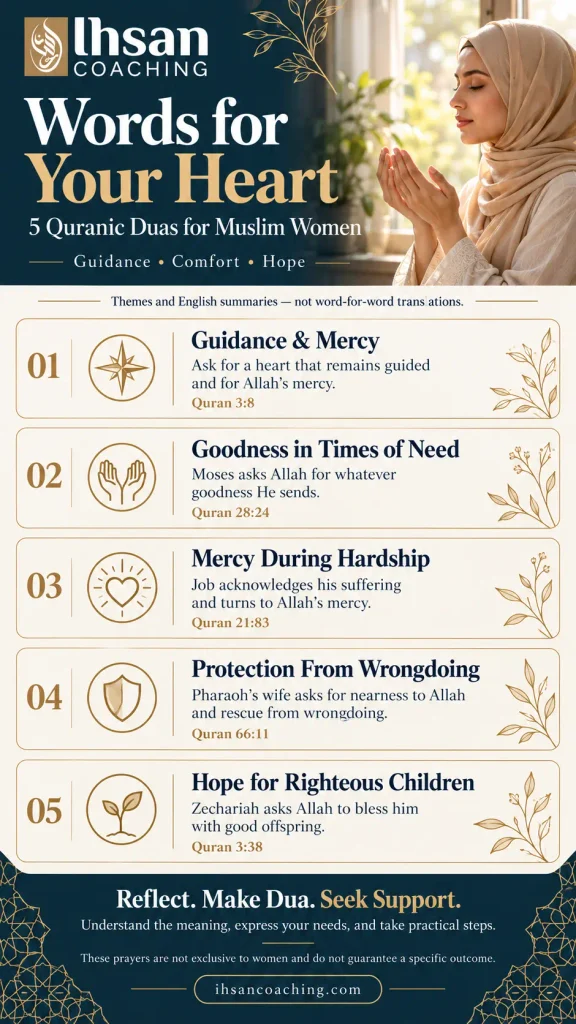
| Steadfast guidance and mercy | Quran 3:8 | A supplication for hearts to remain guided |
| Goodness when you feel in need | Quran 28:24 | Moses asks Allah for good after helping others |
| Mercy during suffering | Quran 21:83 | Job turns to Allah in affliction |
| Protection from wrongdoing | Quran 66:11 | Pharaoh’s wife asks for nearness to Allah and rescue |
| Righteous children | Quran 3:38 | Zechariah asks Allah for good offspring |
These prayers can be relevant to women with different responsibilities and aspirations. Marriage and motherhood are important parts of some women’s lives, but they do not define every woman’s needs or spiritual journey.
1. Dua for Guidance and a Steady Heart
Source: Quran 3:8
English meaning: Our Lord, keep our hearts from turning away after You have guided us. Grant us mercy from Yourself; You are the generous Giver. Quran.com
This prayer asks for continued guidance and mercy. Its central concern is remaining faithful to guidance, rather than obtaining an immediate answer to a particular decision.
You may reflect on its meaning during a transition, when receiving conflicting advice, or when trying to understand how your values should shape your next step.
How to Connect It With Your Situation
After making the prayer, identify what still needs clarification.
You might need reliable information, a conversation with someone involved, or advice from a qualified religious teacher. A feeling of uncertainty does not mean you must make a rushed decision.
For example, if you are considering a change in work or education, write down the responsibilities, opportunities, and concerns involved. Prayer can accompany that process of careful consideration.
2. Dua for Goodness When You Feel in Need
Source: Quran 28:24
English meaning: My Lord, I am in need of whatever goodness You send to me.
The verse records Moses helping two women water their animals, withdrawing into the shade, and then turning to Allah with this request. It is a broad expression of need. Quran.com
This prayer can be meaningful when you are unsure how to put a complicated situation into words. You may need stability, useful opportunities, supportive relationships, or help meeting everyday responsibilities.
It should not be presented as a guaranteed formula for marriage, employment, or financial gain.
How to Connect It With Your Situation
Name one need you can address practically.
That might mean asking someone for help, arranging an appointment, applying for an opportunity, or making time to rest.
You do not need to interpret every difficulty as a hidden message or know why it has happened before seeking support.
If your main concern is finding a spouse, explore the separate guide to duas for marriage.
3. Dua for Mercy During Pain and Hardship
Source: Quran 21:83
English meaning: Harm has touched me, and You are the most merciful of those who show mercy.
This verse records Job acknowledging his affliction and appealing to Allah’s mercy. It offers an example of bringing suffering into prayer honestly. Quran.com
You do not have to disguise pain as gratitude or pretend that a difficult situation feels easy. The prayer’s wording acknowledges hardship.
A woman experiencing illness, grief, or emotional strain may find its meaning relevant. That application does not make it a prescribed treatment for a particular condition.
How to Connect It With Your Situation
Consider what kind of care you need alongside prayer:
- Practical help with responsibilities.
- Time with someone you trust.
- Medical attention for a health concern.
- Professional support for persistent emotional distress.
Avoid judging your faith by how quickly your symptoms or circumstances change. Prayer should not become another test that you feel you are failing.
4. Dua for Protection From Wrongdoing
Source: Quran 66:11
English meaning: My Lord, prepare a home for me near You in Paradise. Rescue me from Pharaoh and his conduct, and from people who act unjustly.
The Quran presents Pharaoh’s wife as an example for believers and records her request for nearness to Allah and deliverance from wrongdoing. She is commonly known in Islamic tradition as Asiya. Quran.com
Her prayer includes an explicit request for rescue. It should not be used to pressure women into accepting mistreatment as proof of patience.
How to Connect It With Your Situation
If you are experiencing threats, abuse, or controlling behavior, seek confidential support appropriate to the situation. Where there is immediate danger, prioritize safety and local emergency assistance.
Prayer can accompany protective action. You do not need to wait until you feel spiritually stronger before asking for help.
For related information, read about the rights of women after divorce in Islam.
5. Dua for Righteous Children
Source: Quran 3:38
English meaning: My Lord, bless me with good offspring from Your generosity. You hear supplication.
This is Zechariah’s prayer. The verse explicitly identifies him as the person calling upon Allah. Quran.com
Women and men who hope for children may reflect on its meaning. However, it should not be described as a guaranteed fertility treatment or a promise that pregnancy will happen within a certain time.
The prayer concerns offspring specifically. It should not be relabeled as a source-based formula for every delayed ambition.
How to Connect It With Your Situation
If you are experiencing fertility difficulties, you can seek appropriate medical advice and emotional support alongside prayer.
Be considerate when sharing this prayer with someone else. Unsolicited advice about having children can be painful, especially when a person’s circumstances are private.
A woman’s worth is not measured by marriage, pregnancy, or motherhood.
Are These Duas Only for Women and Girls?
No. The supplications in this guide are not restricted to women.
The article focuses on circumstances women may encounter, but the prayers include requests relevant to many people: guidance, mercy, goodness, protection, and family hopes.
If you searched for a “Muslim girl dua” or a “dua for girls,” you can begin with a prayer whose meaning you understand. There is no separate set of these five supplications that every girl must recite.
For a young person, a parent or trusted teacher can help explain the source and meaning without presenting prayer as a guarantee of examination results, popularity, or a particular future.
What Is a Suitable Dua for Her?
If you want to pray for your daughter, sister, mother, wife, or friend, you can express care for her in your own words.
Original personal supplication in English:
O Allah, grant her guidance, well-being, and protection. Help her through what is difficult, surround her with trustworthy support, and bless her with what is good.
This wording is a suggested personal prayer, not a Quranic verse or a quotation attributed to the Prophet Muhammad.
You can also ask what practical support she would appreciate. Listening, respecting her choices, and helping with a task may be more useful than assuming you know what she needs.
How Can Women Include Dua in Daily Life?
Begin with a manageable practice centered on understanding.
- Choose one prayer. Select a meaning that relates to your present concern.
- Read its context. Understand who spoke it and what the passage addresses.
- Express your own need. Outside formal prayer, you can add personal words in English.
- Identify a practical step. Consider whether information, support, rest, or action would help.
- Return without pressure. You do not need to complete all five prayers every day.
This is an optional reflection routine, not a prescribed religious sequence.
Are Daily Duas the Same as the Five Daily Prayers?
No. Personal supplication and the prescribed ritual prayers are distinct.
This article explains Quranic supplications. It does not teach the movements, timing, or detailed rules of formal daily prayer.
If you are learning those practices, seek instruction from a qualified teacher rather than treating a list of duas as a complete prayer guide.
When Can You Make Dua?
You can make personal supplication throughout the day; you do not need to wait for a crisis.
Religious sources also highlight particular opportunities. These include the last third of the night, discussed in Bukhari 1145, and supplication during prostration, encouraged in Muslim 482. sunnah.com
If you want to use particular wording within formal prayer, ask a qualified religious teacher about the applicable rules.
A recommended time should not be presented as a guarantee that a specific request will be fulfilled immediately.
What if You Still Feel Overwhelmed After Making Dua?
You may continue to feel upset, uncertain, or tired after praying. That experience alone does not establish that your prayer was rejected or that your faith is weak.
Avoid placing pressure on yourself to experience an immediate emotional change.
If distress persists or affects daily functioning, seek appropriate professional assessment. Spiritual support can accompany healthcare, but a prayer list should not be presented as treatment for depression, anxiety, or another health condition.
You may also find the article on Muslim mental health in today’s society helpful as a starting point for further discussion.
Finding Support That Respects Your Faith
Different concerns call for different kinds of help.
- Religious questions: Seek an appropriately qualified religious adviser.
- Goals, routines, or decisions: Explore coaching and confirm the provider’s relevant experience.
- Mental health concerns: Consult a qualified healthcare professional.
Ihsan Coaching offers information about religious consultation and individual coaching. Explain your needs before booking and ask which service is suitable.
Seeking support does not require you to stop making dua. Equally, a coach should not claim to know why a particular prayer appears unanswered.
Frequently Asked Questions
Which Dua Should a Muslim Woman Read Every Day?
There is no requirement established here to read this particular set of five daily. Quran 3:8 is one option for reflecting on guidance and mercy. Choose a prayer you understand and can return to without turning the routine into a burden.
Can I Make Dua in English?
Personal supplication outside formal ritual prayer can be expressed in English or another language you understand. The rules for recitation and supplication within formal prayer are a separate question.
Can I Combine Quranic Duas With My Own Words?
Yes, in personal supplication outside formal prayer, you can reflect on a Quranic prayer and then express your own needs. Keep the original verse and your added wording clearly distinguished when writing or sharing them.
Is There a Special Dua for Every Problem Women Face?
Not every situation has a uniquely prescribed supplication. Broad Quranic prayers for guidance, mercy, and goodness can be meaningful across different circumstances. Avoid assigning special benefits or guaranteed results without reliable evidence.
Were These Prayers All Spoken by Women?
No. This selection includes prayers associated with Moses, Job, and Zechariah, as well as the prayer of Pharaoh’s wife and a supplication for steadfast guidance. Their relevance to women does not change who originally spoke them.
Is Quran 19:24 a Dua Recited by Mary?
No. It records reassurance addressed to Mary. It can be read and reflected on, but it should not be labeled as a supplication she herself recited.
Does Dua Guarantee Marriage, Pregnancy, or Relief From Hardship?
These verses should not be used to guarantee a particular personal outcome or timeline. You can make sincere requests while also taking appropriate practical steps and seeking support.
Do I Need Ritual Ablution for Personal Dua?
Ritual ablution is not a prerequisite for ordinary personal supplication. Rules concerning formal prayer and handling or reciting the Quran are separate matters; seek qualified guidance where needed.
This article provides educational explanations and English paraphrases of Quranic passages. Individual religious questions and health concerns should be discussed with appropriately qualified professionals.