


Summary:
The rights of women after divorce in Islam include protections concerning financial maintenance, the bridal gift, personal property, fair provision on separation, children, and dignified treatment. The precise entitlement depends on the type of divorce, marriage contract, personal circumstances, and religious interpretation. Civil law also determines enforceable rights to support, property division, and parenting arrangements. A divorced woman should understand these matters separately before accepting a settlement or signing away a claim.
Divorce can leave a woman facing immediate questions: Where will I live? What financial support is available? Can I keep my belongings? How will my children be cared for?
These questions deserve clear answers. However, there is no single financial or custody arrangement that applies to every Muslim divorce.
Understanding the main rights is a useful starting point. The next step is to establish which rules apply to your circumstances and how any agreement can be documented and enforced.
What Are the Main Rights of Women After Divorce in Islam?
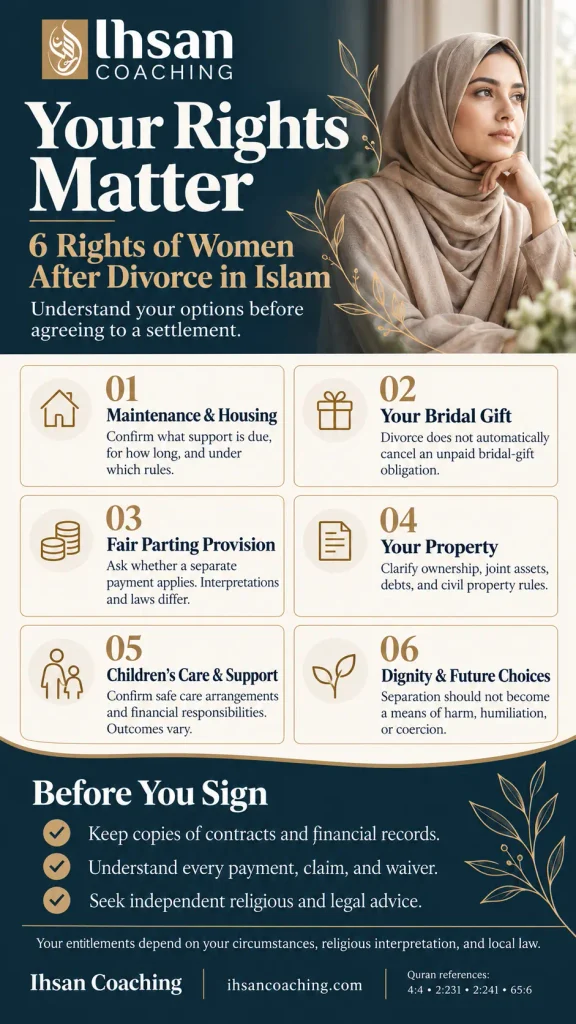
The following table outlines six important areas to clarify. It is a guide to the questions that need answering, rather than a fixed settlement for every divorce.
| Area of Protection | General Principle | What to Confirm |
|---|---|---|
| 1. Maintenance and housing | Support and accommodation can be due during the applicable waiting period. | Divorce type, pregnancy, expenses covered, duration, and applicable rules |
| 2. Bridal gift | Divorce does not automatically cancel an outstanding bridal-gift obligation. | Contract terms, amounts paid, separation route, and any valid settlement |
| 3. Fair provision on separation | The Quran addresses reasonable provision for divorced women. | Whether a separate payment is required and how it is assessed |
| 4. Personal property | Marriage does not automatically transfer a woman’s property to her husband. | Ownership evidence, joint assets, debts, and civil property rules |
| 5. Children’s care and support | Divorce does not end parental responsibilities. | Care arrangements, financial support, safety, and enforceable orders |
| 6. Dignity and future choices | Separation should not become a means of harm or humiliation. | Protection from coercion, access to advice, and requirements for remarriage |
1. What Maintenance and Housing Are Due After Divorce?
Maintenance means financial support for living needs. In discussions of divorce, it is important to distinguish support during the religious waiting period from longer-term civil spousal support.
Maintenance and housing are generally recognized during a revocable divorce’s waiting period. Other situations, including an irrevocable divorce or wife-requested release, require closer assessment rather than assuming that identical rules apply.
Quran 65:6 addresses accommodation according to means, prohibits using hardship to pressure women, and specifically directs support for pregnant divorced women until delivery. Quran.com
What Expenses Should Be Clarified?
Ask how the applicable arrangement treats:
- Housing and essential utilities.
- Food and clothing.
- Healthcare and pregnancy-related expenses.
- Necessary transport or other living costs.
- Existing unpaid support.
Do not assume that every expense is covered in full under every interpretation or legal system. Obtain a clear explanation of the amount, payment dates, and duration.
Is the Waiting Period Always Three Months?
No. The calculation depends on circumstances such as menstruation, pregnancy, and the type of separation.
Quran 2:228 describes three periods for the circumstances it addresses. This should not be converted into a universal three-calendar-month rule. Quran.com
Ask the authority handling the religious separation to confirm the start and end dates. A religious waiting period should not be assumed to determine the duration of every civil support obligation.
Must a Woman Remain in an Unsafe Home?
Housing rules should not be used to pressure someone into remaining in danger.
Where there is abuse, threats, or coercive control, seek confidential assistance about safe accommodation and legal protection. Religious advice about residence can be obtained alongside those protective steps.
2. Does a Divorced Woman Keep Her Bridal Gift?
The bridal gift, commonly called Mahr, is an entitlement belonging to the wife. Quran 4:4 directs that it be given to women and distinguishes a voluntary waiver from an obligation to surrender it. Quran.com
Divorce does not automatically erase an unpaid balance. However, the amount due and payment timing must be assessed using the marriage contract and the circumstances of separation.
What Happens to an Unpaid Amount?
Gather the marriage contract and any records showing:
- The agreed amount or property.
- What was paid.
- What was deferred.
- Any specified payment date or triggering event.
- Any later agreement or disputed waiver.
A deferred amount may become payable on divorce under the relevant arrangement, but avoid assuming that every contract uses identical terms.
For further background, read what the bridal gift means in Islam.
What if the Marriage Was Not Consummated?
Quran 2:237 addresses divorce before consummation where a bridal gift was specified, describing half of the specified amount unless an applicable waiver or concession is made. The circumstances still need assessment; this is not a rule to apply without checking the full situation. Quran.com
Does Requesting Divorce Mean Returning Everything?
No. Requesting separation does not automatically mean surrendering all property or financial claims.
Wife-requested release, often called Khula, may involve returning the bridal gift or agreeing to financial terms. That arrangement should not be confused with every other form of dissolution.
Before signing, ask exactly which rights the proposed agreement affects and whether independent advice is needed.
3. Is a Woman Entitled to a Separate Parting Payment?
The Quran addresses reasonable provision for divorced women in Quran 2:241. This is discussed in Islamic jurisprudence as provision or a parting payment following separation. Quran.com
However, scholars differ over its scope and when it is obligatory or recommended. National legislation may also establish particular eligibility rules and calculations. Egypt’s Dar Al-Ifta explicitly discusses these differences.
This payment should not automatically be treated as identical to:
- An unpaid bridal gift.
- Living expenses during the waiting period.
- Child support.
- Division of jointly owned property.
- Civil spousal support.
Ask whether a separate provision applies, how it is calculated, and whether it overlaps with any other payment under the applicable law.
4. What Happens to a Woman’s Property, Savings, and Gifts?
A woman’s ownership should not be assumed to disappear because she marries or divorces. However, determining ownership and resolving a financial settlement can involve more than whose name appears on a receipt.
Distinguish between:
- Property owned before marriage.
- Inheritances.
- Gifts made specifically to one spouse.
- Jointly purchased assets.
- Loans between spouses.
- Household items with disputed ownership.
- Contributions to a home or business.
Does She Have to Return Jewelry?
Do not assume that every item of jewelry must be returned.
First establish whether it was a completed gift, part of the bridal gift, a loan, or property belonging to someone else. A financial settlement may raise separate questions that require advice.
Photographs, receipts, messages, and witness accounts may help clarify disputed ownership. Preserve relevant evidence where it is safe to do so.
What About a Home Purchased Together?
Joint ownership, mortgage liabilities, contributions, and civil family-property rules must be considered.
It would be misleading to promise that a woman will always receive exactly her original contribution or that every asset in her name is automatically excluded from a civil settlement.
For example, in Canada, property-division rules are established by provincial and territorial law. Religious ownership principles and the enforceable civil outcome therefore need to be considered separately. justice.gc.ca
5. How Do Child Custody and Child Support Work After Divorce?
Children’s care and financial support are related but distinct matters. An arrangement about where children live does not by itself answer every question about who pays their expenses or makes important decisions.
Islamic jurisprudence gives significant attention to maternal care, particularly for young children. However, custody conditions and outcomes differ across interpretations and legal systems. A blanket promise of automatic maternal custody would be inaccurate. dar-alifta.org
What Should a Parenting Arrangement Cover?
Clarify:
- Where children will live.
- Safe contact with each parent.
- Schooling and healthcare decisions.
- Handover arrangements and communication.
- Holidays and travel.
- Any protection needed because of abuse or threats.
Children should not be used to pressure a parent into surrendering financial claims.
Who Pays Child Support?
Islamic teachings place substantial financial responsibilities on fathers. Quran 2:233 addresses reasonable provision in the context of nursing and warns against harming either parent through the child. Quran.com
However, the enforceable amount, expenses included, and duration of child support depend on the applicable law and circumstances.
For example, Canadian guidance identifies financial support as a child’s right and explains that the relevant guidelines depend on the family’s situation. Do not assume that one universal formula applies to all Muslim families. justice.gc.ca
Does Support End at a Fixed Age?
There is no single answer that covers every jurisdiction and religious interpretation.
Age, education, disability, dependency, and existing orders may affect the duration. Avoid relying on a simple rule that support always ends when a son reaches adulthood or a daughter marries.
6. How Is a Divorced Woman’s Dignity Protected?
Divorce should not become a means of humiliation, retaliation, or control.
Quran 2:231 directs honorable treatment and warns against retaining a woman in order to harm her. This provides an important ethical foundation for how separation should be handled. Quran.com
Respectful treatment includes avoiding threats, malicious accusations, and pressure to accept an unfair arrangement.
Protecting privacy does not mean that a woman must remain silent about abuse or cannot speak with a lawyer, religious adviser, therapist, or other appropriate source of support.
Can a Divorced Woman Marry Again?
Yes, when the applicable religious and civil requirements are met.
Quran 2:232 addresses preventing women from remarrying after their waiting period when an acceptable agreement has been reached. Quran.com
The requirements differ depending on whether she intends to marry a new partner or return to a former spouse. Read the guide to divorce and remarriage in Islam for those distinctions.
Is There Alimony in Islam?
“Alimony” is an English legal term commonly used for support paid to a former spouse. When people ask about alimony in Islam, they may be referring to several different financial obligations.
| Payment | What It Addresses |
|---|---|
| Waiting-period maintenance | Living support during an applicable religious waiting period |
| Unpaid bridal gift | An outstanding marriage-related financial obligation |
| Parting provision | A payment considered under the relevant religious interpretation or legislation |
| Civil spousal support | Support assessed under the applicable family law |
| Child support | Financial provision for children, separate from the former spouse’s own needs |
There is no useful universal answer that every payment called “alimony” is either required or prohibited. The payment’s basis, purpose, and applicable framework need to be identified.
Similarly, the end of the religious waiting period does not automatically cancel a civil spousal-support order. Obtain legal advice before stopping payments or abandoning a claim.
What Should a Woman Do After Divorce to Protect Her Rights?
Start by organizing the information needed for informed advice.
1. Confirm Both Religious and Civil Status
Keep copies of religious decisions and civil divorce documents. Ask whether further steps are needed and which date applies to each process.
2. Separate the Financial Questions
List the bridal gift, maintenance, property, debts, child support, and any proposed parting payment separately.
This makes it easier to identify what has been paid, what is disputed, and what remains unresolved.
3. Prepare a Practical Expense Record
Record housing costs, essential bills, children’s expenses, and relevant healthcare needs. Keep supporting documents where available.
4. Review Any Agreement Before Signing
Understand whether the document contains a financial waiver, property transfer, parenting agreement, or acknowledgment of payment.
Do not sign a statement saying you received money if it has not been received.
5. Ask How the Arrangement Can Be Enforced
A religious adviser can explain religious obligations, but not every religious council has the powers of a civil court.
Ask a local family-law professional which claims can be pursued, what evidence is needed, and whether deadlines apply.
Finding the Right Support After Divorce
Different concerns require different expertise.
A qualified religious adviser can explain the relevant religious framework. A family-law professional can assess enforceable financial and parenting rights. Emotional support can help with the personal adjustment and decisions that follow separation.
If you contact Ihsan Coaching, explain the support you need and ask about the provider’s qualifications and service scope. Coaching does not replace legal representation or a formal religious determination.
Frequently Asked Questions
Does a Woman Lose Her Rights if She Initiates Divorce?
Not automatically. The route used and any valid agreement can affect particular financial claims. Requesting separation should not be treated as an automatic waiver of the bridal gift, personal property, or every other entitlement.
Can a Muslim Woman Seek Divorce if Her Husband Refuses?
She can seek advice about the available dissolution routes. A husband’s refusal does not determine every case, but an authority’s powers, grounds, and procedures must be established. The financial consequences should be explained before she agrees to a settlement.
What if a Former Husband Refuses to Pay the Bridal Gift?
Keep the marriage contract and evidence of the unpaid amount. Seek religious advice about the obligation and legal advice about recognition and enforcement where you live. Do not assume that every religious council can seize assets or that every civil court treats the contract identically.
Is the Bridal Gift the Same as Alimony?
No. The bridal gift arises from the marriage arrangement. Alimony commonly refers to civil spousal support. Waiting-period maintenance, parting provision, and child support are also distinct matters, even when several are considered in one settlement.
Can a Working Woman Still Receive Support?
Employment does not answer every entitlement question. Her income may affect some civil support assessments, while other claims arise from different obligations. Each payment should be considered separately.
Does Taking a Job Automatically Cause a Mother to Lose Custody?
An employment decision should not be treated as a universal custody disqualification. Care arrangements, safety, the child’s needs, and applicable rules require consideration. Existing court orders should also be reviewed before making major changes.
Does Remarriage Automatically End Every Financial Right?
No single rule covers every payment. Remarriage may affect some support arrangements, while unpaid debts or child-support obligations involve different considerations. Confirm the effect on each entitlement before assuming that all payments end.
Can Leaving an Unsafe Home Affect My Rights?
Safety should come first. Leaving can raise questions about residence, evidence, and particular claims, so obtain advice as soon as it is safe to do so. Do not assume that leaving automatically forfeits all financial or parenting rights.
This article provides general educational information. Individual entitlements, religious rulings, and legal enforcement should be confirmed with qualified advisers familiar with the circumstances and jurisdiction.