


Summary:
A Muslim coach helps clients clarify goals, explore obstacles, and take practical steps while respecting their faith and personal circumstances. Individual coaching can address decisions, routines, communication, boundaries, and life transitions. Choosing a suitable coach involves checking their qualifications, approach, confidentiality policies, and scope of practice. Coaching does not replace mental health treatment or qualified religious advice when those services are needed.
You may know that something needs to change without knowing where to begin. Perhaps you keep postponing an important decision, struggle to protect time for yourself, or feel pulled between personal goals and family expectations.
Individual coaching offers a structured opportunity to explore those concerns and decide what to do next. For some Muslims, working with someone who understands the role of faith can make these conversations easier to begin.
However, shared faith is only one part of finding suitable support. A useful coaching relationship also needs clear goals, relevant expertise, and room for your individual experiences.
What Does a Muslim Coach Do?
A Muslim coach works with clients to identify what they want to change, understand what makes that change difficult, and develop achievable next steps.
Depending on the coach’s training and the agreed focus, sessions may involve:
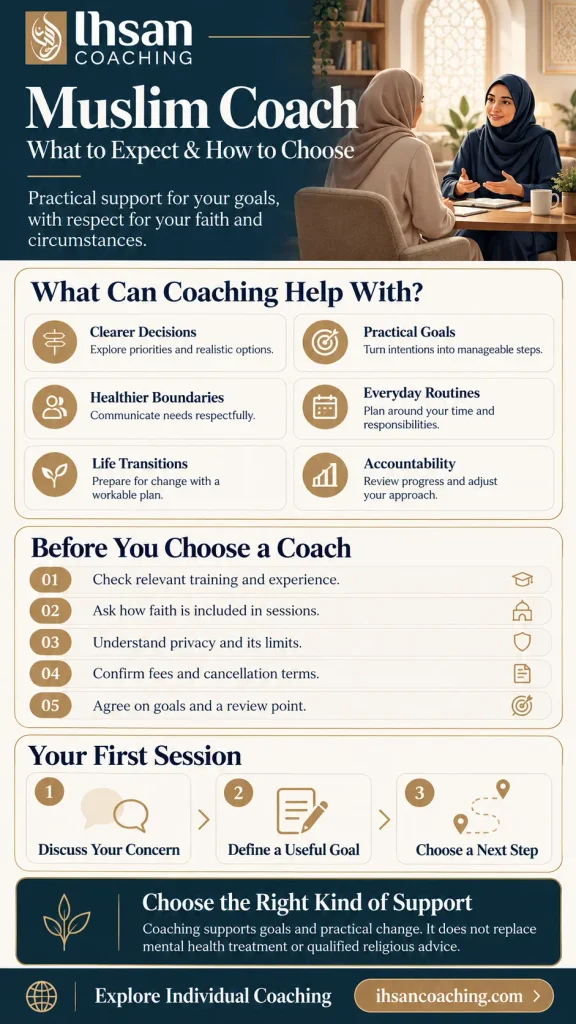
- Clarifying a decision or personal priority.
- Exploring habits that interfere with a goal.
- Practicing a difficult conversation.
- Planning realistic routines.
- Reviewing progress and adjusting expectations.
- Identifying when another professional would be better placed to help.
The coach should help you think through your choices rather than make important life decisions on your behalf.
For example, if you are considering a career change, the work might involve identifying your priorities, discussing practical constraints, and planning conversations with potential employers. The outcome is a clearer decision process, not a promise that one career choice will solve every difficulty.
What Is the Difference Between Muslim Coaching and Islamic Coaching?
“Muslim coaching” may describe coaching delivered by a Muslim professional or intended for Muslim clients. “Islamic coaching” usually emphasizes an approach informed by Islamic values.
Providers may use these terms differently. Neither label alone tells you whether someone holds a coaching credential, a clinical license, or qualifications in religious scholarship.
Before booking, ask how faith enters the work. Does the coach invite reflection on your values? Do they discuss religious sources? How do they handle questions that require a qualified religious adviser?
You should also be able to explain how much emphasis you want placed on faith during sessions. Muslims differ in their backgrounds, religious understanding, family experiences, and personal priorities. A coach should explore those differences rather than assume that every Muslim client needs the same approach.
What Can Individual Coaching Help With?
Individual coaching is most useful when the concern can be translated into a meaningful goal and practical actions.
The examples below illustrate possible coaching goals. They are not client testimonials or guaranteed outcomes.
| Concern | Possible Coaching Focus | Example of Progress |
|---|---|---|
| Uncertainty about a decision | Clarifying priorities and comparing realistic options | Identifying the information needed before making a choice |
| Difficulty following through | Breaking a goal into smaller steps and reviewing obstacles | Completing a manageable action before the next session |
| Overcommitment | Reviewing responsibilities and practicing boundaries | Declining an additional commitment respectfully |
| Communication difficulties | Preparing clear requests and listening more carefully | Having a planned conversation without avoiding the main issue |
| Competing work and family demands | Building a schedule that reflects available time and energy | Protecting a realistic period for an important responsibility |
| A major life transition | Identifying changing needs and sources of support | Creating a practical plan for the next stage |
A coach cannot control another person’s behavior, remove every external barrier, or guarantee a particular outcome. The work should focus on decisions and actions that are realistically available to you.
Clarifying Goals Without Adding More Pressure
A broad goal such as “be more successful” can be difficult to act on. Coaching can help you define what success means in your circumstances.
For one person, it may mean applying for a new role. For another, it may mean reducing commitments and making time for family.
A useful goal is specific enough to guide action but flexible enough to account for real responsibilities.
Setting Boundaries While Respecting Relationships
Some clients find it difficult to express a preference when they worry about disappointing relatives, colleagues, or community members.
A coaching conversation can help distinguish between what you can offer, what you cannot sustain, and how to communicate that clearly.
For example, a boundary might sound like: “I can help on Saturday morning, but I cannot take responsibility for the whole event.”
The purpose is to develop honest, workable communication. Questions about a specific religious obligation should be taken to someone qualified to address them.
Building Accountability That Fits Your Life
Accountability should involve reviewing what happened and learning from it.
If you did not complete an agreed action, useful questions include:
- Was the step too large?
- Did you have the time and resources it required?
- Was the goal actually important to you?
- Did an unexpected responsibility change your priorities?
- Would a different approach be more realistic?
This makes accountability a process of adjustment rather than a reason for shame.
How Is Coaching Different From Therapy or Religious Consultation?
The appropriate service depends on the kind of help you need. Some professionals hold more than one qualification, but the service they are providing should still be clearly identified.
| Service | Main Purpose | What to Clarify |
|---|---|---|
| Individual coaching | Working toward agreed goals, decisions, habits, and practical changes | The coach’s training, relevant experience, and limits of practice |
| Mental health therapy | Assessing and treating mental health concerns, alongside other therapeutic goals | Professional credentials, authorization to practice, and suitability for your needs |
| Religious consultation | Addressing questions about religious teachings and their application | The adviser’s qualifications and the scope of the consultation |
Therapy can also address present-day goals and future plans. The distinction is not simply that therapy discusses the past while coaching discusses the future.
Coaching alone is not a substitute for assessment or treatment of a mental health condition. If distress is persistently affecting daily functioning, a qualified mental health professional can help assess what support is appropriate. The International Coaching Federation provides guidance on referring clients when their needs fall outside a coach’s competence.
A provider’s clinical qualifications also do not automatically make every coaching appointment a therapy session. Ask which service you are receiving and what professional responsibilities apply.
How Do You Choose a Muslim Coach?
Choose a coach based on relevant competence, clear professional boundaries, and how well the approach fits your needs.
1. Check Qualifications and Relevant Experience
Ask what training the coach has completed and what kinds of concerns they regularly work with.
A degree, coaching credential, clinical license, and religious qualification represent different forms of preparation. If a provider advertises a credential, check the issuing organization or relevant professional register where available.
Experience should also match your goal. A coach who focuses on workplace leadership may not be the right fit for a complicated family situation.
2. Ask How Sessions Work
Find out whether sessions involve discussion, exercises, action planning, or activities between appointments.
You should understand how goals are agreed and when progress will be reviewed. Ask what happens if the initial approach is not helping.
3. Discuss Faith and Cultural Expectations
Explain which aspects of your faith or background matter to the concern you are bringing.
A suitable coach should be willing to ask questions rather than make assumptions about your marriage, family roles, culture, or level of religious practice.
Shared identity can support understanding, but it does not replace listening.
4. Understand Privacy and Confidentiality
Before sharing sensitive information, ask:
- What records are kept?
- Who can access them?
- Are sessions recorded?
- What are the limits of confidentiality?
- Could information be shared with a family member or someone paying for sessions?
Ask for the relevant policies in writing. Avoid assuming that confidentiality has no exceptions.
5. Confirm Costs and Practical Arrangements
Clarify the session fee, duration, cancellation policy, and whether a package is optional.
For online coaching, ask about the platform, time zone, privacy requirements, and availability where you live. If the service includes regulated clinical care, location can affect whether the professional is authorized to provide it.
6. Notice Whether You Can Ask Questions Freely
You should be able to disagree, raise concerns, and ask why an exercise is being suggested.
Promises of guaranteed transformation, pressure to purchase immediately, or advice to stop prescribed treatment are reasons to reconsider the provider.
What Happens in an Individual Coaching Session?
The exact structure varies, but an initial session should help both you and the coach decide whether the service fits your needs.
A typical discussion may include:
- Your reason for seeking support: What is happening, and why does it matter now?
- Your preferred outcome: What would meaningful progress look like?
- Your circumstances: What responsibilities, resources, and constraints need to be considered?
- The working agreement: What does coaching include, and what falls outside its scope?
- A manageable next step: What could you try before another appointment?
Later sessions can review what you attempted, what you learned, and whether the goal or approach needs to change.
You do not need a polished explanation of your problem before seeking an initial conversation. “I know I am stuck, but I am not sure what support I need” is a reasonable starting point.
A Practical Example: Turning Overcommitment Into a Coaching Goal
Imagine someone who regularly agrees to extra tasks at work and in their community. They then struggle to complete existing responsibilities and feel frustrated with themselves.
An initial goal might be: “I want to stop feeling overwhelmed.”
A more workable coaching goal could be: “Before accepting another commitment, I will check my current responsibilities and give myself time to respond.”
The person might agree to:
- List existing commitments.
- Identify which tasks are essential and which are optional.
- Prepare a respectful response when they need time to decide.
- Try that response once.
- Review what made it easier or harder.
Progress is observable: the person has changed how they respond to requests. It does not require every source of pressure to disappear.
This is an illustrative example, not a reported Ihsan Coaching client outcome.
How Can You Prepare for Your First Coaching Appointment?
A few notes can make the conversation more useful.
Before the appointment, consider:
- The main concern: What would you most like to discuss?
- A recent example: When did the difficulty show up?
- Previous attempts: What have you already tried?
- Your priorities: Which values or responsibilities should the coach understand?
- A useful outcome: What would make the first conversation worthwhile?
- Your questions: What do you need to know about the provider or service?
For an online appointment, choose a private space where you can speak comfortably. Ask in advance if privacy, accessibility, or technology could be a difficulty.
How Do You Know Whether Coaching Is Helping?
Review progress against the goals you agreed, rather than judging the experience only by whether a session felt encouraging.
Possible signs of progress include:
- You can describe the decision or problem more clearly.
- You are taking actions that were previously being postponed.
- Your plans better reflect your available time and resources.
- You can communicate a need or boundary more directly.
- You recognize when a different kind of support is needed.
Agree on a review point with the coach. If little is changing, discuss whether the goal, working relationship, approach, or type of service needs to change.
Coaching should not continue indefinitely without a clear purpose.
Exploring Individual Coaching at Ihsan Coaching
Ihsan Coaching offers individual coaching with an emphasis on personal goals and Islamic values. Its service page provides information about the approach, appointment options, and current fees.
Before booking, explain what you hope to work on and ask which provider’s experience is relevant. Confirm whether you are seeking coaching, mental health treatment, or religious guidance so the service can be identified clearly.
You can book an appointment to discuss your needs and the available options.
Frequently Asked Questions
Do I Need a Major Problem to Work With a Muslim Coach?
No. You may seek coaching for a specific decision, a routine you want to establish, or a goal you have struggled to act on. The important question is whether coaching fits the concern and whether the provider has relevant expertise.
Does a Muslim Coach Have to Include Religious Teaching in Every Session?
Not necessarily. Providers use different approaches. Some explicitly discuss religious sources, while others focus on practical goals in a way that respects the client’s faith. Ask how faith will be included and explain your preferences before beginning.
Is an Islamic Coach the Same as a Religious Scholar?
No. The title “Islamic coach” does not by itself establish qualifications in religious scholarship. A coach may help you reflect on values and decisions, but a question requiring a religious ruling should be addressed by an appropriately qualified adviser.
Can I Receive Coaching While Attending Therapy?
Sometimes. The services should have clear, compatible goals and appropriate boundaries. Discuss the arrangement with your therapist and coach. If coordination would help, agree on what information can be shared and provide the necessary consent.
How Many Coaching Sessions Will I Need?
There is no universal number. It depends on the goal, its complexity, the approach, and your circumstances. Ask when progress will be reviewed and whether you can begin without committing to a long package.
Can I Request a Male or Female Coach?
You can express a preference and ask about availability. Comfort can be important when discussing personal matters, alongside the provider’s relevant qualifications, experience, and approach.
Will a Coach Tell Me What Decision to Make?
A coach should help you examine options, responsibilities, and consequences while respecting your ability to decide. Be cautious if someone pressures you into a major personal decision or presents their preference as the only acceptable choice.
How Much Does Muslim Coaching Cost?
Fees vary by provider, session length, and package. Check the current published price and confirm cancellation terms, any additional charges, and what the fee includes. Ihsan Coaching lists appointment options on its individual coaching service page.