
Summary
“Understanding mahr is essential for every Muslim planning marriage. Learn about Islamic rulings on bridal gifts, recommended amounts based on Sunnah, and practical advice for determining mahr that honors both Islamic tradition and modern circumstances.”
If you’re planning an Islamic marriage, you’ve likely encountered the term “mahr.” But what exactly is mahr in Islam, and why does it matter?
Mahr is often misunderstood for a bride price or confused with dowry. In reality, mahr is a mandatory gift from the groom to the bride that’s hers alone to keep. It’s not optional or symbolic, it’s a divine command from Allah.
This guide explains everything you need to know about mahr: its significance, appropriate amounts based on Sunnah, and practical advice for modern Muslim couples. Whether you’re determining how much mahr to give or simply learning about Islamic marriage, you’ll find authentic guidance here.
What is Mahr in Islam?
The Islamic Definition
Mahr (مهر in Arabic) is a mandatory gift that a groom gives to his bride as part of the Islamic marriage contract (nikah). Allah commands it clearly in the Quran:
“And give the women [upon marriage] their [bridal] gifts graciously.” (Quran 4:4)
وَآتُوا النِّسَاءَ صَدُقَاتِهِنَّ نِحْلَةً ۚ فَإِن طِبْنَ لَكُمْ عَن شَيْءٍ مِّنْهُ نَفْسًا فَكُلُوهُ هَنِيئًا مَّرِيئًا
The Quran uses several terms for mahr Saduqat (sincere gifts), Nihlah (pleasant gift), and Ajr (compensation) each emphasizing the bride’s exclusive right to this gift.
Mahr vs. Dowry: Key Differences
Many confuse mahr with dowry, but they’re fundamentally opposite:
| Aspect | Mahr (Islamic) | Dowry (Cultural) |
| Direction | Groom → Bride | Bride’s family → Groom |
| Religious status | Mandatory in Islam | No Islamic basis |
| Ownership | Bride’s exclusive property | Often goes to groom’s family |
| Purpose | Bride’s right & security | Cultural tradition |
| Islamic ruling | Obligatory (Wajib) | Prohibited if demanded |
Islam came to abolish treating women as property. Mahr does the opposite it establishes a woman’s financial independence from day one.
Why Mahr Matters: Spiritual & Legal Significance
A Woman’s Exclusive Right
The mahr belongs exclusively to the bride. Not her parents, family, or anyone else. The Quran states:
وَءَاتُوا۟ ٱلنِّسَآءَ صَدُقَٰتِهِنَّ نِحْلَةً ۚ فَإِن طِبْنَ لَكُمْ عَن شَىْءٍ مِّنْهُ نَفْسًا فَكُلُوهُ هَنِيٓئًا مَّرِيٓئًا
“But if they give up willingly to you anything of it, then take it in satisfaction and ease.” (Quran 4:4)
Only the woman herself can choose to forgo or share her mahr and this must be completely voluntary, never forced.
Symbol of Respect and Commitment
Beyond legal obligation, mahr represents:
- The groom’s sincerity and commitment
- Respect for the bride’s value
- Willingness to accept financial responsibility
- A tangible expression of the marriage covenant
The Prophet Muhammad ﷺ gave his wives modest but meaningful amounts (400-500 dirhams), demonstrating respect without extravagance.
Foundation for Financial Security
Mahr provides:
- Immediate financial assets the bride controls
- Security cushion for the marriage
- Legal protection (unpaid mahr is a debt)
- Economic independence from the start
Types of Mahr in Islam
Islamic law recognizes different payment structures:
Mahr Mu’ajjal (Prompt Mahr)
- Paid immediately before or at the nikah
- Becomes the bride’s property right away
- Most common form globally
Mahr Mu’wajjal (Deferred Mahr)
- Paid at a later specified date
- Typically due upon divorce, death, or mutual agreement
- Remains a debt until paid
Combined Approach
Many couples split mahr into both portions, offering:
- Immediate acknowledgment and security
- Flexibility for grooms with limited current funds
- Additional long-term protection
Key requirement: All terms must be clearly documented in the marriage contract.
Islamic Mahr Amount: How Much Should You Give?
This is the most common question, and the answer might surprise you.
What the Quran and Sunnah Say
There’s no fixed minimum or maximum in the Quran. Allah gave flexibility across times, cultures, and economic situations.
The Prophet ﷺ taught the most important principle:
“The most blessed marriage is the one with the least burden.” (Sahih Bukhari)
The Prophet’s Practice
For his wives: 400-500 dirhams (roughly 1,200-1,500 grams of silver) modest amounts, not extravagant
For his daughter Fatimah: 480 dirhams moderate despite his high status
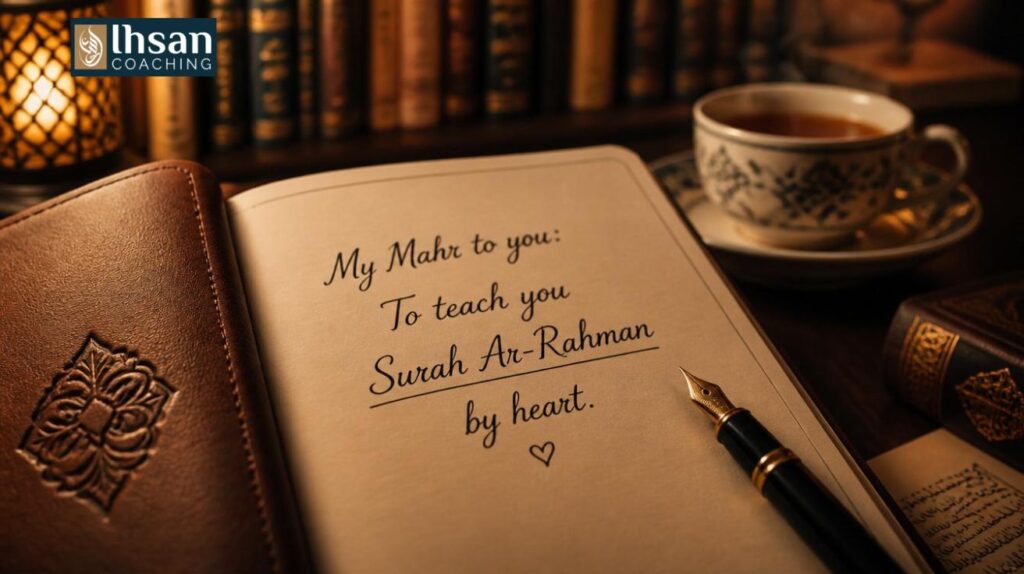
The teaching story: A companion who had nothing was allowed to give teaching Quran as mahr, proving that:
- Mahr doesn’t have to be monetary
- Skills and knowledge count
- Islam facilitates marriage, not creates barriers
Factors to Consider When Determining Mahr Amount
1- The Groom’s Financial Capacity
This is the primary factor. Give what you can afford without:
- Going into debt
- Creating financial hardship
- Delaying other Islamic obligations
As Allah says: “Allah does not burden a soul beyond that it can bear.” (Quran 2:286)
لَا يُكَلِّفُ اللَّهُ نَفْسًا إِلَّا وُسْعَهَا ۚ لَهَا مَا كَسَبَتْ وَعَلَيْهَا مَا اكْتَسَبَتْ ۗ رَبَّنَا لَا تُؤَاخِذْنَا إِن نَّسِينَا أَوْ أَخْطَأْنَا ۚ رَبَّنَا وَلَا تَحْمِلْ عَلَيْنَا إِصْرًا كَمَا حَمَلْتَهُ عَلَى الَّذِينَ مِن قَبْلِنَا ۚ رَبَّنَا وَلَا تُحَمِّلْنَا مَا لَا طَاقَةَ لَنَا بِهِ ۖ وَاعْفُ عَنَّا وَاغْفِرْ لَنَا وَارْحَمْنَا ۚ أَنتَ مَوْلَانَا فَانصُرْنَا عَلَى الْقَوْمِ الْكَافِرِينَ
2- Following Sunnah (Moderation)
Excessive mahr can:
- Contradict the Prophet’s ﷺ example
- Delay marriages unnecessarily
- Create financial stress
- Shift focus from the sacred bond to materialism
3- Regional Context (Without Extravagance)
Be aware of community norms while prioritizing Islamic principles over cultural competition.
Contemporary ranges (2024 estimates):
- USA/Canada: $2,000-$10,000
- UK: £1,500-£8,000
- Middle East: $3,000-$25,000 (varies widely)
- South Asia: $500-$5,000
These are observations, not requirements. The right amount is what both parties agree upon within the groom’s means.
4- The Bride’s Preferences
The bride has the right to:
- Express her preferences
- Accept what she feels is appropriate
- Request specific forms (gold, property, etc.)
Islamic etiquette encourages modesty while considering the groom’s circumstances.
5- Long-term Financial Planning
Consider:
- Future expenses (home, children)
- Whether high mahr delays the wedding
- Overall financial health of the household
What Can Be Given as Mahr?
Valid forms include:
- Cash (most common, easy to transfer)
- Gold and jewelry (holds value, traditional)
- Property/real estate (long-term security)
- Stocks/investments (if halal)
- Teaching Quran or skills (as per authentic Hadith)
- Any valuable asset both parties agree upon
Requirements:
- Must be halal (Islamically permissible)
- Clear, agreed-upon value
- Transferable to bride’s ownership
- Properly documented
Practical Guidelines: Questions to Ask
For Grooms:
- Can I afford this without hardship or debt?
- Am I following the Sunnah of moderation?
- Does this amount delay our marriage unnecessarily?
- Am I choosing this to honor my bride or impress others?
For Brides:
- Is my expectation based on Islamic principles or cultural pressure?
- Am I considering his capacity fairly?
- Would accepting less allow us to marry sooner?
- What form provides the best financial security?
For Both:
- Have we consulted knowledgeable people?
- Are we prioritizing our marriage over the transaction?
- Is our agreement clearly documented?
- Have we prayed to Istikhara about this decision?
Mahr Rights and Responsibilities
The Bride’s Rights
- Full ownership from the moment of nikah
- Right to demand payment at the agreed time
- Right to forgive (but only voluntarily)
- Legal recourse if unpaid (it’s a debt in Islamic law)
The Groom’s Obligations
- Payment is mandatory, not optional
- Prompt mahr is due before or at the wedding
- Deferred mahr becomes due at specified times
- Unpaid mahr remains a debt even after death
Mahr in Divorce
Before consummation: Bride receives half the mahr if divorce occurs (Quran 2:237)
After consummation: Bride entitled to full mahr if unpaid
Husband-initiated divorce: All unpaid mahr must be paid in full
Wife-initiated divorce (Khul’): Mahr may be negotiated as part of the agreement but cannot be forcibly taken
Upon death: Unpaid mahr is a debt on the estate, paid before inheritance distribution
Common Mistakes to Avoid
❌ Treating mahr as a bride price – It’s a gift to honor the bride, not payment for her
❌ Excessive amounts causing hardship – Contradicts the Sunnah of ease
❌ Family taking the mahr – It belongs exclusively to the bride; family claiming it is haram
❌ Making it conditional – Bride’s use of mahr cannot be controlled
❌ No documentation – Always write mahr details in the marriage contract
❌ Indefinite delays – Delaying payment without agreement is oppression
❌ Confusing with dowry – Dowry from bride’s family has no basis in Islam
Frequently Asked Questions
Q: Is mahr mandatory?
Yes, absolutely. It’s commanded in the Quran (4:4) and required for a valid Islamic marriage.
Q: What’s the minimum amount?
There’s no Quranic minimum. Scholars suggest 10-30 grams of silver as symbolic minimums, but any mutually agreed amount is valid even teaching Quran.
Q: Can the bride refuse mahr?
She cannot refuse it as a concept (it’s her right), but she can accept a smaller amount or later forgive it voluntarily.
Q: What if the groom can’t afford it?
He should give what he can afford, offer non-monetary mahr (like teaching Quran), or arrange deferred payment honesty is key.
Q: Can mahr be paid in installments?
Yes, if both parties agree and it’s documented clearly.
Q: Can parents take their daughter’s mahr?
Absolutely not. This is haram. The Quran explicitly gives mahr to the woman herself.
Preparing for Your Mahr Discussion: Actionable Checklist
✅ Educate yourself on Islamic guidelines (Quran, Hadith, authentic sources)
✅ Assess financial capacity honestly without overpromising
✅ Consult knowledgeable people (scholars, imam, counselors)
✅ Involve families appropriately (wali for bride, support for groom)
✅ Prioritize Islamic principles over cultural expectations
✅ Consider both immediate and long-term needs
✅ Document everything clearly in the marriage contract
✅ Seek premarital counseling if discussions become difficult
✅ Pray Salat al-Istikhara for Allah’s guidance
✅ Focus on building a blessed marriage, not just negotiating a transaction
For couples needing guidance with these sensitive discussions, Ihsan Coaching provides Islamic premarital coaching that helps navigate mahr conversations with wisdom and Shariah principles.
Conclusion
Mahr is a beautiful Islamic obligation that honors women, establishes their financial security, and sets the foundation for a blessed marriage. From Allah’s clear command in the Quran to the Prophet Muhammad’s ﷺ practice of moderation, mahr represents respect, commitment, and the bride’s valued status in Islam.
Remember:
- Mahr is the bride’s exclusive right no one else has claim to it
- There’s no fixed amount give what’s affordable and mutually agreed upon
- The Sunnah emphasizes simplicity: “The most blessed marriage is the one with the least burden”
- Documentation protects both parties’ rights
- Cultural practices should never override Islamic principles
Whether you’re a groom determining how much mahr to give, a bride understanding your rights, or families supporting your children, return to the Quran and Sunnah. Approach mahr with knowledge, honesty, generosity within means, and respect for each other’s rights.
The beauty of Islamic marriage begins in how you honor these obligations with Taqwa (God-consciousness). May Allah bless all those preparing for marriage with righteous spouses and unions filled with tranquility, mercy, and love (Quran 30:21).
وَمِنْ آيَاتِهِ أَنْ خَلَقَ لَكُم مِّنْ أَنفُسِكُمْ أَزْوَاجًا لِّتَسْكُنُوا إِلَيْهَا وَجَعَلَ بَيْنَكُم مَّوَدَّةً وَرَحْمَةً ۚ إِنَّ فِي ذَٰلِكَ لَآيَاتٍ لِّقَوْمٍ يَتَفَكَّرُونَ
Need Guidance for Your Marriage Journey?
Ihsan Coaching offers Islamic marriage coaching services including:
- Premarital coaching grounded in Quran and Sunnah
- Guidance on mahr and financial discussions
- Communication skills for Muslim couples
- Support balancing cultural and Islamic expectations
Schedule your consultation today and start your marriage preparation with Islamic wisdom and professional guidance.
Disclaimer: The Quranic verses and Hadith referenced in this article are cited for educational and spiritual reflection purposes. Translation sources used: [e.g. Quran.com, Sunnah.com]. This content is not intended as a fatwa or religious ruling.