
Summary
“Many couples suffer because they prioritize “what people say” over Allah’s pleasure. We explore how to navigate these pressures using emotional intelligence and Islamic wisdom.”
Marriage in Islam is described as half our Deen (faith) and a source of tranquility (Sakinah). However, for many young Muslim couples today, the journey to tranquility is blocked by a heavy, invisible barrier: culture.
Imagine this scenario: A husband and wife are happy with each other, but their home is filled with tension. The arguments aren’t about their love, but about how much gold was bought for the wedding, why the daughter-in-law visited her parents “too often,” or why the son is helping his wife in the kitchen.
These are cultural marriage conflicts. They occur when societal traditions are prioritized over Islamic teachings, often leading to unnecessary stress, financial burden, and emotional distance between spouses.
While culture can be beautiful offering us language, food, and community, it becomes problematic when it contradicts the laws of Allah (SWT). When “what will people say” becomes more important than “what does Allah please,” the foundation of the marriage begins to crack.
In this comprehensive guide, we will explore the roots of these conflicts, distinguish clearly between cultural vs Islamic marriage rules, and offer practical solutions to navigate Muslim marriage culture problems without breaking family ties.
Understanding the Root of the Problem
To solve cultural marriage conflicts, we first have to understand where they come from. It is rarely a case of parents or in-laws being “evil.” Instead, these conflicts are often rooted in deep-seated fears and generational conditioning.
1- The Fear of “Log Kya Kahenge”
In many South Asian, Arab, and African communities, the concept of honor is tied strictly to public perception. The phrase “Log Kya Kahenge” (What will people say?) drives decision-making. Parents may fear that if their son moves out, or if their daughter marries someone from a different ethnicity, the community will gossip. This fear of social ostracization pushes families to enforce strict cultural norms, even if those norms hurt their children’s happiness.
2- Confusing Culture with Religion
A significant root cause of conflict is the lack of Islamic knowledge among older generations. Many elders were raised believing that certain cultural traditions (like the caste system or specific wedding rituals) are actually religious requirements. When a young couple tries to practice a more authentic version of Islam, it is often viewed as rebellion rather than piety.
3- Collectivism vs. The Couple
Most Muslim cultures are collectivist, meaning the “we” (the extended family) is more important than the “I” (the individual) or even the “us” (the couple). While Islam emphasizes respecting parents, it also establishes the husband and wife as a distinct unit with their own privacy and rights. The friction arises when the extended family refuses to recognize the couple’s autonomy.
Cultural vs Islamic Marriage: Spotting the Difference
Confusion creates conflict. If you cannot distinguish between a cultural demand and a religious obligation, you will struggle to set boundaries. Here is a breakdown of cultural vs Islamic marriage expectations.
1- The Wedding Ceremony (Nikah vs. Show)
- Culture: Often demands lavish, multi-day weddings costing tens of thousands of dollars. Families go into debt to impress guests. The bride’s family is often burdened with unfair expenses.
- Islam: Encourages the Nikah to be simple. The Prophet Muhammad (PBUH) said, “The marriage which produces the most blessings is that which is of least burden.” (Al-Bayhaqi). Islam emphasizes a simple proposal, the Nikah contract, and a Walima (feast) provided by the groom within his means.
2- Choosing a Spouse
- Culture: Heavily focuses on caste, tribe, skin color, and financial status. Parents may reject a suitor solely because they are from a different village or ethnicity.
- Islam: The Prophet (PBUH) advised looking for four things: wealth, lineage, beauty, and religion. He emphasized, “Choose the one who is religious, may your hands be rubbed with dust (prosper).” (Bukhari). Piety (Taqwa) and good character are the only true metrics for a Muslim spouse.
3- Rights and Roles
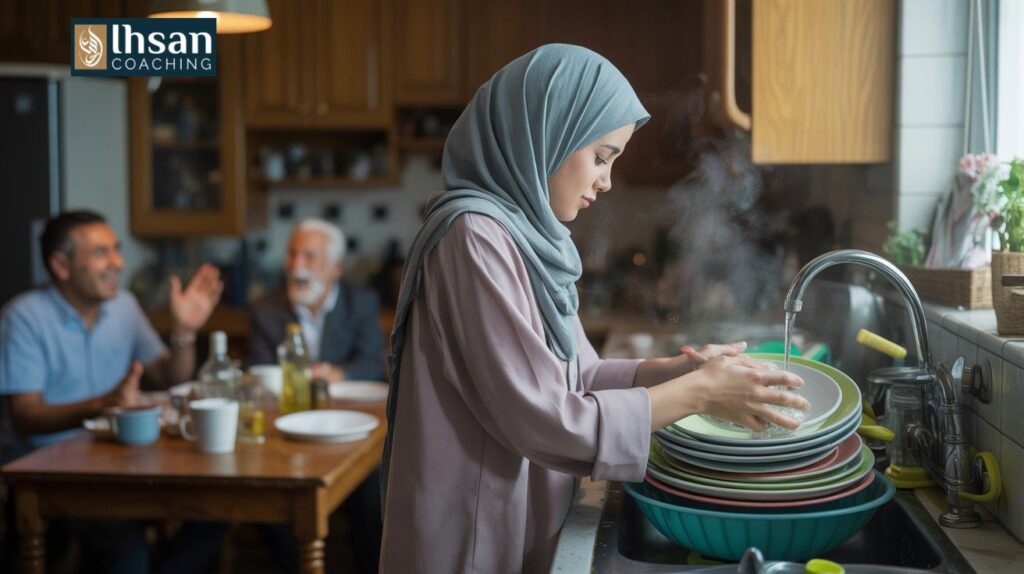
- Culture: Often treats the daughter-in-law as a subordinate to the mother-in-law, expecting her to serve the entire household while neglecting her own well-being. Conversely, culture may dictate that a husband cannot show affection to his wife in front of his parents.
- Islam: Establishes clear, balanced rights. The wife has no Islamic obligation to serve her in-laws (though she may do so out of kindness/Ihsan). Her primary responsibility is to her husband and her Lord. The husband is commanded to treat his wife with the utmost gentleness and is responsible for her accommodation and maintenance (Nafkah).
Common Muslim Marriage Culture Problems
When cultural pressure overrides Islamic wisdom, specific pain points emerge. These Muslim marriage culture problems are the most common complaints we see at Ihsan Coaching.
The Joint Family System Struggle
Living with in-laws is the single most significant source of cultural marriage conflicts.
While living together is not Haram (forbidden) in Islam, it is often practiced in a way that violates the rights of the wife. Culturally, a son leaving his parents’ home is seen as abandonment. However, Islamically, a wife has the right to separate accommodation (Sukan Shar’i), which includes a private entrance, kitchen, and bathroom, free from the intrusion of others.
When couples are forced to live in a joint family system without privacy, it breeds resentment. The wife feels constantly monitored, and the husband feels torn between his duties as a son and a husband.
Financial Abuse and Mahr
In some cultures, the Mahr (dowry) is treated as a status symbol to be boasted about, demanding exorbitant amounts that the groom cannot afford. In other cultures, the groom’s family demands “dowry” from the bride’s family (cash, cars, furniture) a practice that is strictly forbidden in Islam and resembles Hindu customs.
Furthermore, culture often dictates that a husband’s salary belongs to his parents, leaving the wife with no financial security. Islam is clear: the husband’s wealth is his own, and he must provide for his wife and children first.
The Stigma of Divorce
Culture says: “Divorce is death. Stay in an abusive marriage for the sake of the family name.”
Islam says: Divorce is disliked but permissible (Halal) as a last resort. Allah (SWT) allows divorce to save individuals from oppression and misery.
Because of cultural stigma, many Muslims remain in toxic or abusive marriages for decades, suffering in silence because they fear the community’s judgment more than they trust in Allah’s plan.
The Impact on Mental Health and Iman
These conflicts are not just “family drama”; they are spiritual and psychological hazards. When a person is subjected to constant cultural marriage conflicts, the toll on mental health is severe.
Resentment and Burnout
When a wife feels she is being treated as a maid rather than a partner, or a husband feels he is being used as an ATM for the extended family, resentment builds. This resentment eventually turns toward the spouse. “Why didn’t you stand up for me?” becomes the recurring argument. This leads to emotional burnout, where one or both partners simply “check out” of the relationship.
Spiritual Disconnect
Perhaps the most dangerous side effect is the impact on one’s relationship with Allah. When culture is presented as religion, victims of cultural abuse often feel that Islam is unjust. They may think, “If Islam says I have to suffer like this, I don’t want it.”
It is crucial to understand that this pain is not from Islam. Islam came to liberate us from the tyranny of unjust customs. Realizing this distinction is the first step toward healing your mental health and your Iman.
Actionable Solutions to Navigate Conflicts
You cannot change your parents or your society overnight, but you can change how you navigate these challenges. Here are strategies based on Islamic principles and emotional intelligence to handle cultural marriage conflicts.
1- Knowledge is Your Shield
You cannot enforce boundaries if you do not know your rights. Study the Fiqh of marriage. Understand exactly what constitutes a wife’s rights (Huquq) and a husband’s responsibilities. When you realize that your desire for privacy or respect is valid in the eyes of Allah, you gain the confidence to speak up.
- Tip: Approach these discussions not as a rebellion, but as a desire to follow the Sunnah more perfectly.
2- The “United Front” Strategy
The husband and wife must be on the same team. You should discuss your boundaries privately and agree on them. When facing the extended family, the husband should generally be the spokesperson to his parents, and the wife to hers. This protects the spouse from being the “villain.”
For example, if the wife needs more privacy, the husband should approach his parents and say, “I feel we need more space for our marriage,” rather than “My wife wants to move out.”
3- Compassionate Communication (Adab)
Islam commands excellence (Ihsan) and kindness to parents, even when they are wrong. Setting boundaries does not mean shouting or disrespect. You can be firm on your rights while remaining soft in your speech.
Use the “Sandwich Method”:
- Start with validation/affection (“Mom, I love you and appreciate everything you do”).
- State the boundary clearly (” However, for the sake of our marriage, we have decided to make this change…”).
- End with reassurance (“This doesn’t mean we will visit less; we want to keep our bond strong”).
4- Prioritize Your Spouse
Culturally, men are often taught that their mother comes first in everything. While the mother has a high status in Islam, the wife has the primary right to her husband’s time and intimacy. A man cannot neglect his wife to please his mother; this is oppression (Zulm).
Shift your mindset: You are not “choosing” your wife over your mother; you are fulfilling the distinct rights Allah has assigned to each of them.
5- Seek Professional Help
Sometimes, the cultural web is too tangled to unweave alone. If you are stuck in a cycle of arguments, involving a neutral third party is essential. A culturally competent coach or counselor can help mediate. They can validate your feelings and provide scripts on how to talk to difficult family members without escalating the conflict.
Conclusion
Cultural marriage conflicts are difficult because they mix our love for family with our need for peace. However, as Muslims, our ultimate loyalty is to Allah and His Messenger (PBUH).
Remember, culture is meant to serve us, not enslave us. When traditions cause harm, injustice, or marital discord, they must be set aside in favor of the justice and mercy of Islam. You have the right to a peaceful, loving marriage. You have the right to privacy. And you have the right to raise your family according to Islamic values, free from the pressure of “what people will say.”
Navigating this path requires courage, wisdom, and patience.
Are cultural marriage conflicts draining your relationship?
You don’t have to navigate this alone. At Ihsan Coaching, we help couples align their marriage with Islamic values for lasting peace. We provide the tools you need to set boundaries with respect and restore the love in your home. Book a consultation today and take the first step toward the tranquil marriage you deserve.