

Summary
“Understanding the role of a Wali in an Islamic marriage is essential for every Muslim woman planning to wed. This guide explains Islamic rulings, addresses concerns of converts and those with absent fathers, and provides practical advice for finding a wali in Western contexts.”
You’re ready to get married, but one requirement is causing confusion: the Wali. If you’re a Muslim woman in America especially a convert, someone with a non-Muslim father, or living far from family you’re probably asking: “Who can be my wali? Do I really need one?”
The Wali in Islam marriage is your guardian in the marriage contract. Far from being about control, the Wali protects your interests and ensures your marriage begins on solid Islamic ground. This guide answers who qualifies as your Wali, whether you can marry without one, and practical solutions for finding a wali in America.
What is a Wali in an Islamic Marriage?
A Wali (ولي) is a guardian who represents the bride during the nikah. The Prophet ﷺ said: “There is no marriage except with a Wali.” (Sunan Abu Dawud)
The Purpose: Protection, Not Control
The wali provides:
- Experience in evaluating potential spouses
- Protection against exploitation
- Verification of the groom’s character and stability
- Representation of your interests
What the Wali is NOT:
- Someone who can force you to marry
- A controller of your decisions
- Entitled to reject suitable matches for invalid reasons
Critical: Your consent is mandatory. The Prophet ﷺ said: “A virgin should not be given in marriage except after her permission.” (Bukhari)
Wali vs. Father
Your father is the default Wali, but NOT if he’s:
- Non-Muslim
- Unjust or abusive
- Of unsound mind
- Refusing proper Wali duties
In these cases, the role passes to the next eligible relative or a Wali hakim (Islamic authority/imam).
Who Can Be Your Wali?
The Priority Order:
- Father (if Muslim, sane, just)
- Paternal grandfather
- Full brother
- Half-brother (father’s side)
- Paternal uncle
- Son (if previously married)
- Other paternal male relatives
- Wali hakim (imam/Islamic authority)
Requirements for Valid Wali:
✅ Muslim
✅ Male (majority opinion)
✅ Adult
✅ Sound mind
✅ Just and trustworthy
If your highest-ranking potential Wali doesn’t meet these, the role automatically passes down the hierarchy.
Can I Marry Without a Wali?
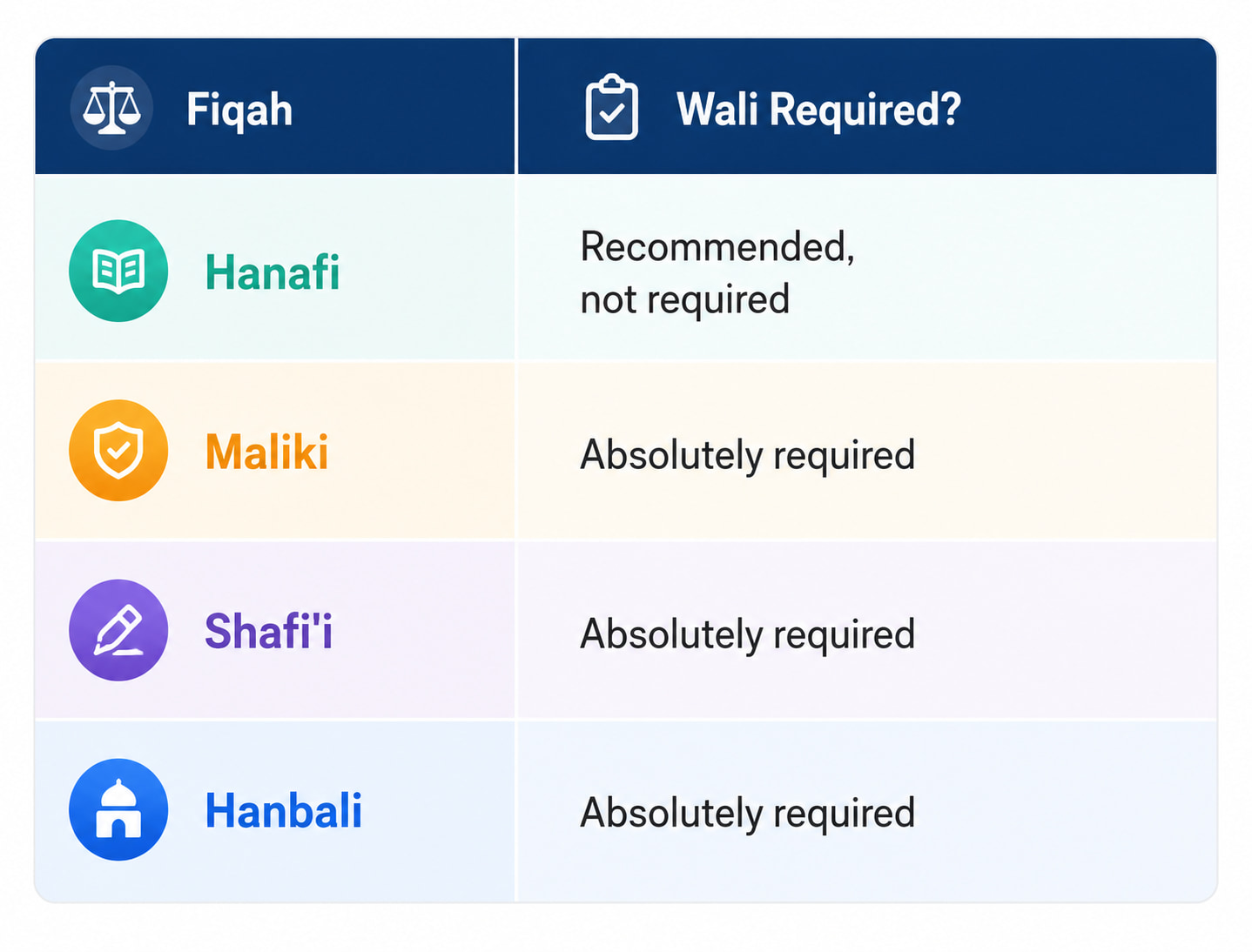
Majority Position (Maliki, Shafi’i, Hanbali)
Wali is absolutely required. Marriage without one is invalid or irregular.
Evidence: Hadith “There is no marriage except with a Wali” and the Prophet ﷺ nullifying marriages conducted without Walis.
Hanafi Position
An adult woman can contract her own marriage, though having a Wali is strongly recommended.
Conditions:
- Must be adult and sane
- Groom must be suitable match
- Wali can still object if groom is unsuitable
Guidance: Follow your madhab, but the safer opinion is having a Wali. Consult a scholar about your specific situation.
Wali for Muslim Women in America: Special Cases
Converts to Islam
Your situation: Non-Muslim father means he can’t be your Wali.
Solution:
- Contact your local Islamic center
- Request the imam serve as Wali hakim
- Provide shahada documentation
- Share information about potential spouse
Organizations like ISNA and ICNA also provide this service. This is a well-established Islamic provision you’re not “less than” other Muslim women.
Women with Absent Fathers
Father overseas: He can participate via video call or delegate a representative (wakil) with written authorization.
Father unreachable: Role passes to next in hierarchy (grandfather, brother, uncle). If none available, seek Wali hakim.
Women with Unjust or Abusive Fathers
Islamic ruling: Unjust fathers can be disqualified.
Examples of unjust behavior:
- Abuse (physical, emotional, financial)
- Refusing every spouse without valid reasons
- Demanding unreasonable conditions
- Racism or cultural prejudice
- Using Wali role to control your life
Your recourse:
- Document behavior
- Consult Islamic scholar
- Request role pass to next relative
- Seek Wali hakim if needed
This is NOT disobedience. Protecting yourself through proper Islamic channels is your right.
For navigating these situations, Islamic guidance can help you proceed safely while maintaining Islamic compliance.
Divorced or Widowed Women
Question: Do previously married women need a wali?
Answer: According to majority scholars, yes. Your consent carries more weight (you’re experienced), but a wali is still recommended or required depending on the madhab.
Hanafi position: Even more independence for previously married women.
The Wali Hakim: When the Imam Steps In
Wali hakim = judicial guardian when you have no eligible family member.
When It Applies:
- Convert with no Muslim male relatives
- All eligible relatives deceased/non-Muslim
- Relatives disqualified (unjust, absent)
- No male relatives exist
Who Qualifies in America:
✅ Imam at reputable Islamic center
✅ Islamic scholars with community authority
✅ Islamic organizations (ISNA, ICNA)
How to Request:
- Contact local mosque
- Explain situation
- Imam will verify and meet potential spouse
- Conducts or participates in nikah
- Get written confirmation
Most imams provide this service without charge.
Your Rights as a Muslim Woman
- Your Consent is Absolutely Mandatory
No one can force you to marry. The Prophet ﷺ nullified forced marriages.
Your “yes” must be:
- Freely given
- Clear and explicit
- Not coerced
- Valid vs. Invalid Reasons for Wali Refusal
Valid reasons:
- Groom not practicing/openly sinful
- Serious character flaws
- Cannot financially support family
- Ulterior motives
INVALID reasons:
- Different ethnicity/culture
- Different social class
- “Family politics”
- Arbitrary financial expectations
- “We just don’t like him” (without Islamic basis)
If refused for invalid reasons: Involve scholars, request role pass to next relative, or seek wali hakim.
- Red Flags of Wali Abuse
⚠️ Refusing every potential spouse
⚠️ Using marriage to control your life
⚠️ Forcing you to marry specific person
⚠️ Preventing marriage indefinitely
⚠️ Claiming “religious authority” for cultural preferences
Get help from Islamic scholars, counselors, or professional guidance.
Practical Steps: Finding Your Wali
Quick Action Plan:
Step 1: Identify your Wali using the hierarchy
- Father qualified? → He’s your Wali
- If not → Move to next in line
- No family options? → Need Wali hakim
Step 2: For those needing Wali hakim
- Research local Islamic centers
- Meet with imam
- Provide documentation
- Share spouse information
Step 3: Communicate with your Wali
- Inform of marriage intention
- Share spouse details
- Discuss concerns
- Seek wisdom and blessing
Step 4: Document everything
- Written confirmation of Wali
- Include in marriage contract
- Keep all documentation
Frequently Asked Questions
Can I marry without a Wali in the Hanafi madhab?
Hanafi fiqah allows adult women to contract their own marriages, though having a Wali is strongly recommended. The Wali can still object if the groom is unsuitable.
Can my mother be my Wali?
According to majority scholars, the Wali must be male. However, your mother’s wisdom should definitely be considered.
How do I find a Wali as a convert in America?
Contact your local Islamic center and request the imam serve as your Wali hakim. This is a standard Islamic service.
What if my Wali is overseas?
He can participate via video call or authorize someone else as his representative (wakil) with written documentation.
What if my father refuses because of my fiancé’s ethnicity?
Racism is not a valid Islamic reason. This is oppression (Dhulm). Seek help from scholars who can mediate or recognize a Wali hakim instead.
Does a divorced woman need a Wali?
According to Maliki, Shafi’i, and Hanbali schools, yes. Hanafi gives more independence. Follow your madhab, but Wali involvement is recommended.
Conclusion
The Wali in Islam marriage protects and guides you he doesn’t control you. Understanding this role empowers Muslim women in America, especially converts and those with unique circumstances.
Key takeaways:
- Your consent is absolutely mandatory
- Clear hierarchy determines who serves as Wali
- Converts and those with absent fathers have solutions through Wali hakim
- Walis can only refuse for valid Islamic reasons
- Protecting yourself while following Islamic process is your right
Whether you’re a convert seeking a Wali hakim or navigating family dynamics, authentic Islamic guidance provides both protection and empowerment.
Need Guidance?
Ihsan Coaching helps Muslim women navigate Wali requirements, family conflicts, and Islamic marriage preparation with coaching grounded in Quran and Sunnah.
Schedule your consultation for personalized guidance on finding a Wali and preparing for marriage in the West.