


Summary:
Valid reasons for seeking divorce in Islam can include abuse, serious neglect, abandonment, breaches of trust, and an inability to continue married life responsibly. The appropriate separation route depends on the circumstances. Husband-initiated divorce, wife-requested separation, and dissolution by a competent authority involve different considerations. Religious interpretation and local law also affect the procedure, financial arrangements, and recognition of the divorce.
Deciding whether to end a marriage can bring difficult questions about faith, family, children, and the future. Some people worry that their concerns are not serious enough. Others feel pressure to remain in a relationship that has become harmful.
Islam recognizes divorce while placing importance on fairness and responsible treatment. Understanding the reasons for separation is a starting point, but it is equally important to distinguish personal concerns from the formal grounds and procedures applied to an individual case.
What Are Valid Reasons for Divorce in Islam?
Serious mistreatment, failure to meet marital responsibilities, and an unworkable relationship can lead someone to seek separation. However, these circumstances do not all require the same procedure or produce an automatic dissolution.
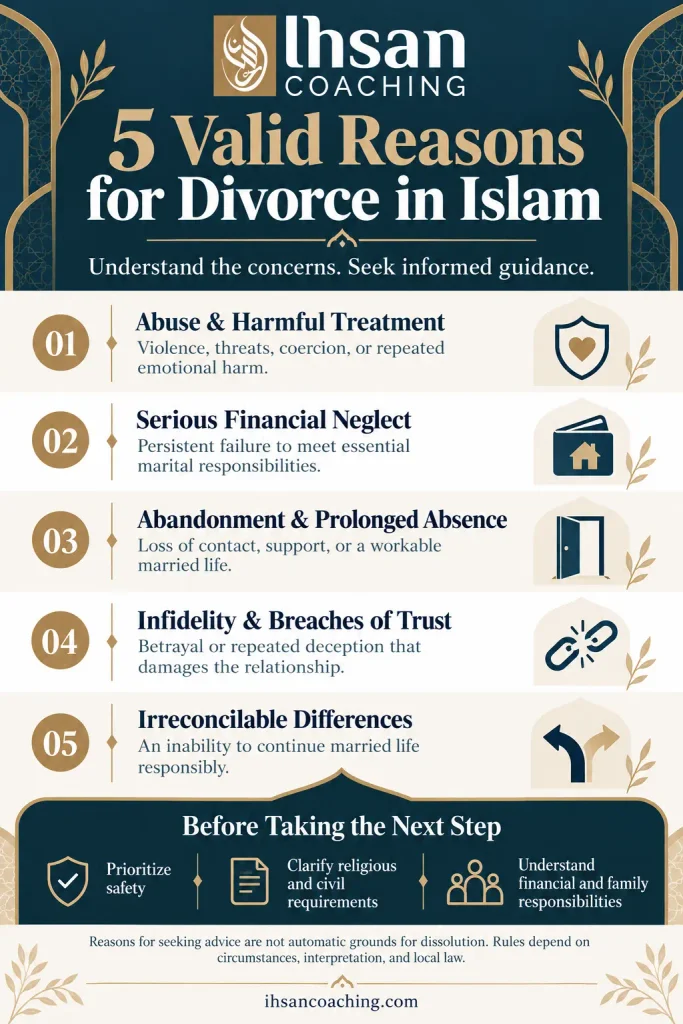
The following five situations explain common reasons for seeking advice about divorce in Islam.
1. Domestic Abuse and Harmful Treatment
Physical violence, threats, sexual coercion, controlling behavior, and repeated emotional degradation are serious concerns. They should not be dismissed as ordinary disagreements or treated as problems that patience alone must resolve.
Quran 4:19 instructs husbands to treat their wives with kindness. Abuse conflicts with that principle.
Someone experiencing abuse can seek confidential advice about protection and separation. A competent authority can explain the relevant dissolution process and evidence requirements. Where there is immediate danger, personal safety takes priority over joint meetings or attempts at reconciliation.
2. Serious Financial Neglect
Persistent failure to provide required financial support can be a reason to seek advice about ending a marriage. Deliberately withholding access to basic necessities may also form part of a pattern of control.
Temporary financial difficulty is different from intentional neglect. An assessment may consider the circumstances, available resources, marital obligations, and applicable rules.
Before accepting a financial settlement, clarify how separation could affect unpaid obligations and the bridal gift agreed at marriage. Do not assume that requesting divorce automatically means giving up every financial entitlement.
3. Abandonment and Prolonged Absence
A spouse’s disappearance or prolonged absence may leave the other partner without practical support or a workable married life. Relevant concerns can include loss of contact, failure to provide support, and refusal to resume marital responsibilities.
There is no single absence period that applies to every Islamic divorce case. Schools of interpretation and national laws differ on the conditions and procedures for dissolution.
When seeking advice, provide a clear timeline of the absence and any attempts to establish contact. Keep relevant records where doing so is safe.
4. Infidelity and Serious Breaches of Trust
Infidelity can cause a profound breakdown in trust. Repeated deception or other serious betrayals may also make continued married life unworkable.
A person considering separation should distinguish between established facts, suspicions, and unresolved concerns. The evidence needed for a particular legal or religious procedure is a separate question from the emotional impact of the relationship.
Avoid public accusations or confrontations that could create further harm. Seek private advice about the available options and the appropriate way to present concerns.
5. Irreconcilable Differences and Inability to Continue the Marriage
Not every separation involves violence or infidelity. A marriage may reach a point where the spouses cannot maintain a workable relationship or fulfill their responsibilities toward one another.
Quran 2:229 discusses retaining a marriage honorably or separating with good treatment. It also addresses release where the couple fears being unable to observe marital boundaries.
An ordinary disagreement does not necessarily mean a marriage must end. However, a wife-requested separation does not always depend on proving a husband’s misconduct. The appropriate route and its consequences require individual consideration.
How Do You Distinguish Marital Conflict From a Persistent Harmful Pattern?
When considering separation, it can help to look at what happens during disagreements and what follows afterward. Are both partners able to express concerns freely? Does either person feel afraid of the consequences of disagreeing? Are promises to change followed by consistent action?
Consider these questions:
- Safety: Can you raise a concern without threats, intimidation, or retaliation?
- Accountability: Does your spouse acknowledge harmful behavior, or repeatedly blame you for it?
- Change: Do improvements continue over time, or does the same behavior return after each apology?
- Independence: Can you access essential money, healthcare, and trusted support without being controlled?
- Boundaries: Are reasonable requests for privacy, space, and respectful communication taken seriously?
You do not need to wait for repeated incidents before seeking help about something serious. Equally, this checklist cannot determine whether a marriage should end or whether a particular dissolution procedure applies.
If it feels safe, write down the concerns you want to discuss privately with an appropriate adviser. Focus on specific behavior and its effect on your daily life rather than trying to give the relationship a label.
What Are Valid Reasons for Divorce in Islam for Women?
Women may seek advice because of any of the concerns above, including abuse, neglect, abandonment, betrayal, or an inability to continue married life.
A useful question is not simply, “Is my reason serious enough?” It is also, “Which separation route applies to my circumstances, and what rights and responsibilities does it involve?”
Women should have an opportunity to explain their concerns privately and understand their options before agreeing to financial terms. A general article cannot determine whether a particular case meets the requirements for judicial or religious dissolution.
What Are the Different Types of Islamic Divorce?
Three commonly discussed routes are husband-initiated divorce, wife-requested release, and dissolution through a competent authority. Other arrangements may also be relevant, including powers provided in a marriage contract.
| Route | General Meaning | Questions to Clarify |
|---|---|---|
| Husband-Initiated Divorce | The husband initiates divorce under the applicable religious rules. | What effect does the statement have? Is the divorce revocable? What documentation is needed? |
| Wife-Requested Release | The wife seeks separation, commonly involving an agreed financial settlement. | Is agreement required? What financial terms apply? Is a court-based route available? |
| Dissolution by a Competent Authority | An authorized judge or religious body considers an application to end the marriage. | What grounds and evidence are required? What authority and recognition does the decision carry? |
These routes are often called Talaq, Khula, and Faskh respectively. They should not be treated as interchangeable.
What Are the Reasons for Khula in Islam?
A wife may request release because she feels unable to continue the marriage, even when she does not accuse her husband of abuse or wrongdoing.
An important account appears in the recorded tradition concerning the wife of Thabit ibn Qays. She did not criticize her husband’s character or religious commitment but expressed concern about continuing the marriage. The Prophet Muhammad instructed the return of the garden she had received as her bridal gift and directed her husband to divorce her.
This account helps explain why reasons for khula in Islam are not limited to proving misconduct. However, it does not establish identical financial terms or procedures for every case.
Before pursuing this route, clarify:
- Whether the process requires agreement or an application to an authority.
- What return or waiver of financial rights is being proposed.
- Whether a different dissolution route is relevant to the circumstances.
- How the outcome affects religious and civil marital status.
Do not assume that a husband’s refusal makes every form of separation impossible. Equally, do not assume that any religious council can dissolve a marriage without an established procedure.
What Should You Prepare Before Seeking Divorce Advice?
Preparing for a consultation can help you explain your situation clearly and leave with more useful answers. You do not need a complete file before asking for help. Begin with the information you already have and the questions that matter most to you.
A Brief Timeline of Your Concerns
Write a short account of what has happened, when the concerns began, and whether they are continuing. Include any periods of separation, attempts to resolve difficulties, and important changes in your circumstances.
Describe specific events where possible. For example, explaining when financial support stopped is more informative than simply saying that your spouse is irresponsible.
Marriage and Separation Documents
If safely available, bring your marriage contract, civil marriage certificate, and any previous separation agreements or religious and court documents.
If divorce statements have already been made, record the wording and circumstances as accurately as you can. Tell the adviser when you are uncertain rather than filling gaps from memory.
Financial and Family Questions
Prepare a list of concerns about housing, income, debts, the bridal gift, and everyday expenses. If children are involved, note their current care arrangements and any immediate needs.
You do not need to decide on a settlement before the consultation. The purpose is to understand which questions require advice and what further information may be needed.
Your Priorities for the Appointment
Choose the main questions you want answered. These might include:
- What options are available in my circumstances?
- Which religious and civil procedures should I clarify?
- What should I understand before signing an agreement?
- What support is available if I cannot safely communicate with my spouse?
- What is the next practical step?
Only gather information you can access safely and lawfully. Do not put yourself at risk to obtain documents, and ask how sensitive information will be stored and shared before sending it.
What Questions Should You Ask a Religious Adviser Before Proceeding?
A useful consultation should help you understand your options, the adviser’s role, and what happens next. You should feel able to ask for clarification, especially before agreeing to a procedure or financial settlement.
What Qualifications and Experience Do You Have With Cases Like Mine?
Ask about the adviser’s relevant training and experience with separation cases. Explain any circumstances that may require particular expertise, such as an overseas marriage, previous divorce statements, or safety concerns.
Also ask which questions fall outside their role and whether another professional should be involved.
Which Religious Interpretation and Legal Framework Are You Applying?
Ask the adviser to identify the framework used to assess your case and explain how it affects the proposed process. If you receive different advice elsewhere, ask what accounts for the difference.
Understanding the basis of the advice is more useful than receiving a conclusion without an explanation.
What Authority Does Your Institution Have?
Ask exactly what the institution can do. Will it provide advice, facilitate an agreement, or consider an application for religious dissolution?
Clarify what documents it can issue and what recognition those documents have. Ask separately whether you need legal advice or civil court proceedings.
What Happens if My Spouse Does Not Cooperate?
Ask how the institution handles unanswered correspondence, refusal to attend, or disagreement about the process. Request an explanation of its notification requirements and any further steps that may be available.
If contacting your spouse could create a safety risk, raise that concern privately before correspondence or meetings are arranged.
What Financial Terms Am I Being Asked to Accept?
Request a clear explanation of each proposed payment, repayment, or waiver. Ask whether the arrangement concerns the bridal gift, outstanding support, property, or another issue.
If you do not understand a term, ask for it in writing and seek appropriate advice before signing. Religious settlement discussions and civil financial rights should be clarified separately.
What Are the Fees, Expected Stages, and Possible Delays?
Ask for a written breakdown of fees and what they cover. Find out which stages require your participation, what information is outstanding, and how you will receive updates.
An estimated timeframe should explain what could cause delays rather than promise a completion date regardless of circumstances.
How Will My Information Be Handled?
Ask who can access your documents, what information may be shared with your spouse, and how the institution will contact you.
Explain whether it is safe to leave messages, send mail, or use a shared email address. Agree on a suitable communication method before sensitive details are exchanged.
What Written Confirmation Will I Receive?
Ask how the outcome will be documented and what the document establishes. Before the case closes, clarify any remaining questions about the effective date, waiting period, financial arrangements, and additional proceedings.
Keep copies of the final documents and ask whom to contact if you later need clarification.
How Does the Islamic Divorce Process Work?
The Islamic divorce process depends on the route being used, the marriage’s history, and the relevant religious and legal framework.
1. Obtain Advice About the Current Marriage Status
Provide the marriage contract and details of previous divorce statements, agreements, or reconciliation. Exact wording and circumstances can matter.
Avoid making additional declarations simply because you believe divorce must be pronounced three times.
2. Establish the Appropriate Route
Discuss whether the situation involves husband-initiated divorce, wife-requested release, or an application for dissolution. Ask who has authority to handle the case and what information is required.
Where reconciliation is safe and freely chosen, support may help the couple consider their options. It should not be used to pressure someone experiencing abuse.
3. Clarify the Waiting Period
Waiting-period rules depend on the type of separation and personal circumstances. Pregnancy and menstrual status can affect the calculation, and interpretations differ in some cases.
Ask the authority handling the separation to explain the start date, applicable rules, and expected completion date. Do not assume that every waiting period is exactly three calendar months.
4. Understand Reconciliation and Finalization
A single revocable divorce can become final when the applicable waiting period ends without reconciliation. Three pronouncements are not required to complete every divorce.
Reconciliation during a revocable waiting period differs from remarriage after it has expired. A new marriage contract and consent are generally required after expiry where remarriage is otherwise permitted.
5. Document Financial and Practical Arrangements
Clarify housing, financial support, outstanding obligations, and arrangements for children. Keep copies of decisions and agreements.
A religious certificate, financial agreement, and civil divorce order serve different purposes. Confirm which documents are required for your situation.
Is Islamic Divorce the Same as Civil Divorce?
Religious and civil divorce are not automatically interchangeable.
A religious authority considers marital status within its religious framework. Civil law determines legal marital status and enforceable arrangements such as property division, financial support, and parenting orders.
For example, Canada requires an application to a court for divorce. A religious separation alone should not be assumed to complete that process.
Ask a local family-law professional whether your marriage is legally recognized and what steps are necessary to end it. Separately, ask a qualified religious authority how the civil proceedings affect your religious marital status.
What Happens to Financial Rights and Children After Divorce?
Separation can raise several distinct financial questions: the bridal gift, outstanding debts, support, housing, and jointly owned property. These should not be combined into an assumption that one spouse automatically receives or loses everything.
The separation route, marriage contract, and applicable law can affect the outcome. Seek advice before signing a waiver or accepting a settlement. You can also explore the rights of women after divorce as a starting point for questions to raise.
Where children are involved, focus on safe and practical arrangements for their care. Parenting responsibilities may include:
- Where children will live and how transitions will work.
- Schooling, healthcare, and important decisions.
- Financial support and everyday expenses.
- Communication between parents.
- Protection from exposure to conflict or abuse.
Do not assume that custody or child support follows one universal rule for all Muslim families. Local courts apply the relevant law, and religious discussions do not replace enforceable parenting or support orders.
Finding Support While Considering Separation
You may need different forms of support for different questions. A qualified religious adviser can explain religious procedures. A family-law professional can advise on legal rights. Emotional support can help you process uncertainty and make practical decisions.
If you contact Ihsan Coaching, explain the kind of guidance you need and ask about the provider’s qualifications and scope of support. Coaching does not replace legal representation or a formal religious determination.
Frequently Asked Questions
Can You Get Divorced if You Are Muslim?
Yes. Islam recognizes divorce. The appropriate procedure depends on the circumstances, the separation route, and the applicable religious and civil requirements.
Does Seeking Advice Mean You Have Decided to Divorce?
No. Asking about your options can help you understand your situation before deciding what to do. An initial advice appointment is different from submitting a formal application or taking another step that may affect your marital status.
When booking, explain that you are seeking information and ask whether the appointment initiates any procedure, creates a formal case, or involves contacting your spouse. This helps you understand the service before sharing sensitive details.
You can use the conversation to clarify your concerns, explore available support, and identify questions that need religious or legal advice. You do not need to arrive with every answer or a final decision.
Can a Muslim Woman Seek Divorce if Her Husband Refuses?
She can seek advice about an application for dissolution or another available route. A husband’s refusal does not settle every case. The competent authority must explain its powers, grounds, evidence requirements, and procedure.
Does a Woman Lose Her Bridal Gift if She Requests Divorce?
Not automatically. Financial consequences differ between separation routes and individual circumstances. Obtain advice before agreeing to return the gift, waive an unpaid amount, or surrender other rights.
Are Valid Reasons for Divorce the Same Across Sunni Schools?
Not in every detail. Sunni schools differ on aspects of dissolution and its consequences. National family laws may also apply particular rules. Ask which framework is being used to assess your case.
What Religious Evidence Discusses Reasons for Separation?
Quran 2:229 addresses marital boundaries and honorable separation. The account of the wife of Thabit ibn Qays also illustrates wife-requested release without an allegation of defective character or religious practice. These sources require contextual interpretation rather than being treated as a universal procedural checklist.
Does Saying Divorce Three Times Count as One Divorce or Three?
Religious interpretations and national laws differ. Do not determine your marital status from a general online answer. Provide a qualified authority with the exact wording, circumstances, and any previous divorce history.
Can Spouses Remain in the Same Home During the Waiting Period?
Residence rules depend on the type of divorce, safety considerations, and applicable law. Do not assume that sharing a home means reconciliation has occurred. Where abuse is present, seek confidential advice about safe accommodation and protection.
This article provides general educational information. Individual religious rulings and legal outcomes require advice from appropriately qualified professionals familiar with your circumstances.