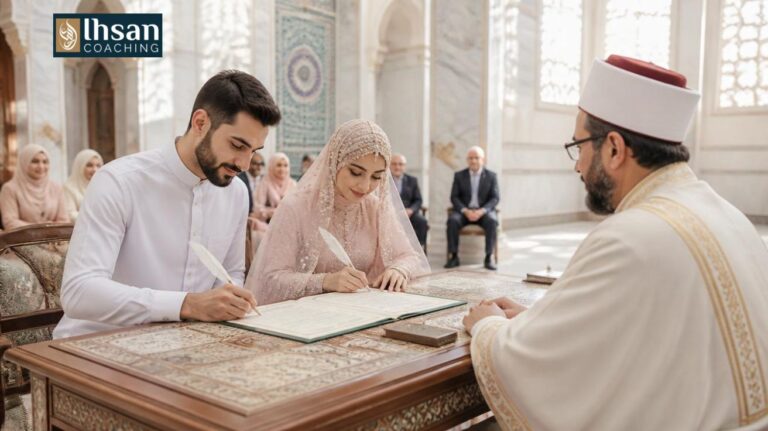
Key Takeaways
- Neither format wins outright: a retreat compresses work into a few intense days, while weekly coaching spreads it over months.
- What decides it: whether your marriage needs a fast reset from an acute crisis or steady work on habits over time.
- Research backs both: concentrated work suits a crisis, while spaced weekly sessions build change that holds.
- Privacy matters here: a visible retreat weekend can draw community attention, and weekly sessions blend into a normal routine.
- What Ihsan Coaching offers: a weekly and biweekly model, not a multi-day retreat format.
Not every struggling marriage needs the same kind of help, and the two most common formats could not look more different.
Marriage retreat vs. weekly coaching: One compresses months of work into a single intense weekend. The other spreads that same work out over months, one quiet session at a time. Which one actually fits your marriage depends less on preference than on where things stand right now.
Quick Answer:
Neither format is universally better. A marriage retreat compresses intensive work into a few concentrated days, while weekly coaching spreads the same work over months so new habits actually take hold. The right choice depends on where your marriage is right now, in acute crisis and needing a fast reset, or working steadily on communication and connection over time, and privacy considerations in close-knit Muslim communities can tip that decision further.
Marriage Retreat vs. Weekly Coaching
Marriage Retreat vs. Weekly Coaching: While a marriage retreat offers an intensive reset for couples seeking focused relationship support, weekly coaching provides consistent guidance and accountability for building lasting change over time.
What Is a Marriage Retreat, Exactly?
A marriage retreat, sometimes called an intensive, concentrates on therapeutic or coaching work into a short, immersive window, typically 2 to 4 days with several hours of structured work each day. According to the Gottman Institute, weekend retreat formats combine both individual and group attention in a psychoeducational setting, often teaching specific relationship skills through structured exercises rather than open-ended conversation.
The appeal is concentration. Instead of one hour a week stretched across months, a couple gets the equivalent of many sessions in a single, focused weekend.
What Does Weekly Marriage Coaching Actually Look Like?
Weekly coaching spreads the same underlying work, communication skills, conflict patterns, and rebuilding trust across regular sessions over several months rather than a single weekend.
The pace is slower by design. Each session builds on the last, with time in between to actually practice a skill in daily life rather than just discuss it in the room.
What Does the Research Say About Which Format Actually Works Better?
The answer isn’t simply about preference. Both formats have research support, and the better fit depends largely on a couple’s starting point and level of distress.
Research discussed by the Gottman Institute describes a “massed sessions with fading” approach for couples who need more intensive support: sessions are concentrated early on, then gradually spaced out as skills and stability improve. This gives partners time to practice new skills between sessions rather than simply discussing their challenges in each appointment.
Typical Format:
A retreat runs 2 to 4 days with several hours of work daily. Weekly coaching runs 45 to 60 minutes, once a week or biweekly.
Best Suited For:
A retreat suits couples in acute crisis or facing real scheduling barriers to ongoing sessions. Weekly coaching suits couples in building sustainable, long-term habits and communication skills.
The Risk to Manage:
With a retreat, momentum can fade after returning to daily life without follow-up. With weekly coaching, progress can feel slow if a couple is in an acute crisis.
Privacy in Tight-Knit Communities:
A dedicated weekend away can raise questions from family or community. Weekly sessions blend into a normal routine with far less visibility.
Intensive formats compress months of structured work into days, typically 12 to 20 total hours of therapeutic work across a retreat, according to descriptions of intensive couples therapy models.
When Does an Intensive Retreat Format Make More Sense?
- You are in acute crisis, such as recently discovering a betrayal, and need immediate, focused attention.
- Your schedules make weekly sessions genuinely impractical for months at a time.
- You want a concentrated reset before starting a longer-term, ongoing process.
A retreat is not a replacement for follow-through afterward. Even strong intensive formats work best when paired with some form of continued support once the couple returns to daily life.
When Does Weekly Coaching Make More Sense?
- You are working on communication patterns and habits, not responding to a single acute crisis.
- You want time between sessions to actually practice what you are learning.
- Your schedule allows for a consistent weekly or biweekly rhythm.
Since lasting behavior change generally takes weeks of repetition to become automatic, an ongoing weekly rhythm gives new habits room to take hold, rather than fading once the intensity of a single weekend wears off.
Privacy and the Weight of Being Seen
Generic marriage advice rarely accounts for this, but it is a real factor for many Muslim couples. A dedicated weekend retreat, especially one involving travel or a visible absence from work and family, can itself raise questions in a tight-knit community.
Islam places real weight on covering what is meant to stay private. The Prophet, peace be upon him, taught that whoever conceals the faults of another will have their own faults concealed by Allah on the Day of Resurrection (Sahih Muslim 2590), a principle many scholars extend to the quiet struggles within a marriage as well.
Weekly online sessions blend into a normal routine with far less visibility. This is one reason Muslim marriage coaching delivered privately and consistently over time appeals to couples who want real progress without an event that draws community attention.
Is There a Middle Ground Between the Two Formats?
Some couples benefit from a hybrid approach: an initial intensive push to break through a specific crisis, followed by ongoing weekly support to make the change durable.
If your situation feels urgent enough that you are considering a retreat, it is worth first having a direct conversation about what is actually needed. Sometimes what looks like a need for an intensive reset is really a need for consistent, ongoing accountability that a retreat alone cannot provide.
What Does Ihsan Coaching Offer?
Ihsan Coaching’s marital coaching program is built around the weekly and biweekly model, not a weekend intensive. For most couples working through communication patterns and rebuilding day-to-day connection, this ongoing structure is what produces change that actually holds once sessions end.
If your situation is closer to an acute crisis needing an immediate, concentrated intervention, say so directly during your consultation so your coach can help you think through whether a different format or a faster initial pace makes more sense for where you are.
Frequently Asked Questions
Is a marriage retreat more effective than weekly coaching?
Neither is universally more effective. Retreats concentrate on work into a short window, which suits acute situations, while weekly coaching spreads work out to build habits that last, which suits ongoing growth. The right choice depends on your specific situation.
Can we do a retreat and then switch to weekly coaching afterward?
Yes. This hybrid approach is common. An intensive reset followed by ongoing weekly support can combine the benefits of both formats.
Is weekly coaching too slow if we are in a real crisis?
Not necessarily. Many coaches increase session frequency temporarily during an acute period, then taper back to a regular weekly or biweekly rhythm once things stabilize.
Does Ihsan Coaching offer an intensive retreat format?
No. Our program is structured around ongoing weekly and biweekly sessions. If you are specifically looking for an intensive multi-day retreat, that is a different service model worth researching separately.
If you are trying to decide which format fits your marriage right now, that is exactly what a first conversation is for. Contact us and we will help you think through what pace and structure actually fits your situation.