


Key Takeaways
- The core problem: coaching is an unregulated industry, so anyone can call themselves a coach with zero training.
- What to actually check: a real coaching credential, verifiable through the certifying body itself, not just the word certified.
- Certified versus licensed: Certified means a coaching credential and licensed means a state clinical license like LMFT or LCSW.
- Verification takes minutes: the ICF’s own public lookup tool confirms whether a credential is genuinely active.
- A separate qualification: no coaching credential or clinical license tells you whether someone understands Islamic values.
Anyone can call themselves a marriage coach tomorrow morning and start taking clients the same day.
There is no license to revoke, no board to report to, and no exam required before someone opens a booking calendar. For a Muslim couple already nervous about who they let into something this personal, that gap is not a minor detail. It is the entire reason vetting matters more here than it would almost anywhere else.
Quick Answer:
Trusting a Muslim marriage coach comes down to checking two separate things. The first is a real coaching credential you can verify directly with the certifying body, not just the word certified with nothing behind it. The second is genuine fluency in Islamic values, meaning actual training or study, not a few references layered onto a generic coaching script. Neither one alone is enough, and both can be checked in a single conversation before you commit.
Why Isn’t Searching for Marriage Coaching Near Me the Best Way to Find a Trustworthy Coach?
Local search feels like the natural instinct, but it works against two things that matter most in this decision. Quality coaches, especially ones who combine a real coaching credential with genuine Islamic knowledge, are rare enough that limiting your search to your own city cuts out most of the qualified options.
A coach based in your own local Muslim community can also raise the exact privacy concern many people are trying to avoid in the first place. Working with a credentialed coach online, regardless of where they are physically based, is usually both a wider and a safer pool to choose from.
What Does Certified Actually Mean in Coaching?
The International Coaching Federation, the largest global body for professional coaches, offers three credential levels. According to the ICF’s own credentialing standards, each level requires a specific number of training hours, logged coaching experience, and a passing score on a credentialing exam.
Associate Certified Coach (ACC):
The entry level credential, requiring a minimum of 60 training hours and 100 logged coaching hours.
Professional Certified Coach (PCC):
The mid-level credential, requiring a minimum of 125 training hours and 500 logged coaching hours.
Master Certified Coach (MCC):
The highest credential the ICF offers requires a minimum of 200 training hours and 2,500 logged coaching hours.
A coach advertising themselves as certified without naming a specific body behind that claim has not actually told you anything verifiable.
How Can You Actually Verify a Coach’s Certification Is Real?
This is the step most people skip, and it takes about two minutes. The ICF maintains a public credential verification tool where you can enter a coach’s name and confirm whether their membership and credential status are genuinely active and in good standing.
If a coach lists a credential from a different certifying body, ask them directly for the name of that body and search for its own public verification page. A legitimate coach will never hesitate to help you confirm this.
Is There a Real Difference Between Certified and Licensed?
Yes, and it matters what you should expect from the relationship. Certified refers to a coaching credential from a training and standards body like the ICF. Licensed refers to a state license, such as a Licensed Marriage and Family Therapist or Licensed Clinical Social Worker, that permits someone to diagnose and treat mental health conditions.
Some coaches hold both. A coach who is also a licensed clinician can sometimes bill insurance for clinical treatment of a diagnosed condition; a distinction covered in more detail in our breakdown of insurance coverage for marriage coaching. Neither credential alone tells you whether a coach understands Islamic values, which is a separate qualification entirely.
What Should You Specifically Look for in a Muslim Marriage Coach?
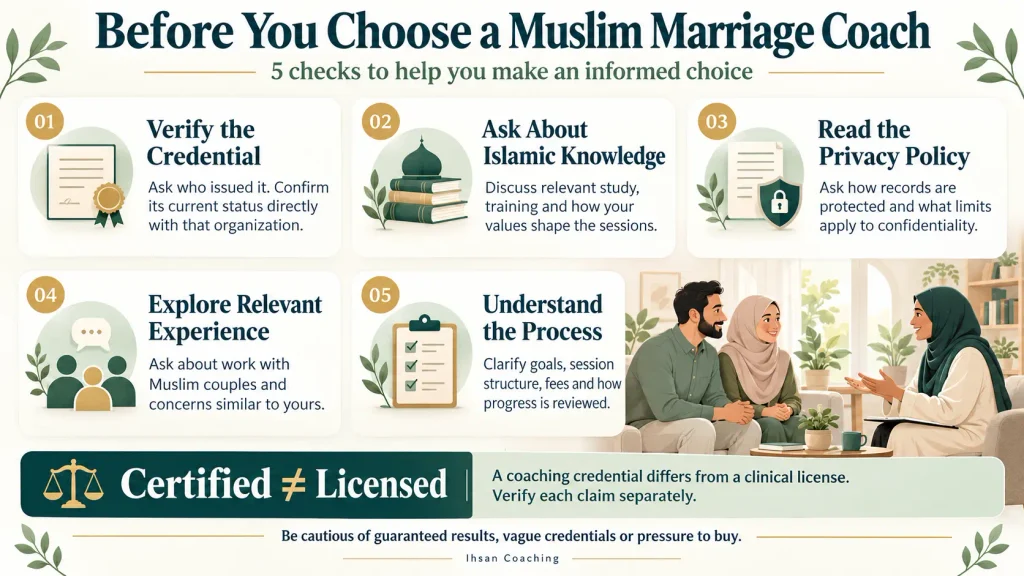
A Real, Verifiable Credential:
A named certifying body you can look up yourself, not just the unsupported word certified.
Genuine Islamic Training, Not Just Identity:
Specific study or training in Islamic knowledge, rather than personal identity as a Muslim standing in for actual qualification.
A Written Confidentiality Policy:
A policy they can explain clearly, in writing, before your first session, not a vague verbal assurance.
A Track Record with Muslim Couples Specifically:
Real experience working with Muslim couples, not generic marriage coaching with a few Islamic references added on top.
A Clear, Structured Process:
A defined process with a sense of direction, rather than open ended conversation with no structure behind it.
What Questions Should You Ask Before You Commit?
- What is your specific coaching credential, and can I verify it independently?
- What is your background in Islamic knowledge or training?
- How many Muslim couples have you worked with, and on what kinds of issues?
- What does your confidentiality policy actually say, in writing?
- What does a typical session structure look like, and how do you measure progress?
A coach who answers all five clearly and without defensiveness has likely thought seriously about how they practice. Hesitation on any of these is worth taking seriously.
What Are the Warning Signs of an Unqualified Coach?
- Vague credentials: using the word certified without naming a specific certifying body.
- Guaranteed outcomes: promising your marriage will be fixed in an exact number of sessions.
- Unclear policies: not being able to explain their confidentiality policy when asked directly.
- Pressure to commit: pushing a large package before you have had an initial conversation.
- Surface level Islamic knowledge: a few general references rather than real training or study.
Trust as an Amanah
Islam treats trust as a serious responsibility, not a casual word. The Prophet, peace be upon him, taught that when a matter is handed to someone not qualified to carry it, that is itself a sign of something gone wrong.
Choosing who helps guide your marriage is exactly this kind of Amanah. Verifying a credential is not a lack of faith in the person. It is taking the responsibility of that trust seriously before you hand over something as personal as your marriage.
How to Start Vetting Without Wasting Time
- Ask directly for the name of the certifying body behind any credential a coach mentions.
- Look the credential up yourself rather than taking the claim at face value.
- Ask the five questions above in your first conversation, before any payment is discussed.
- Treat hesitation or defensiveness on any of them as real information, not a misunderstanding.
Frequently Asked Questions
Does a coach need to be Muslim themselves to provide good Muslim marriage coaching?
Not necessarily, but they do need genuine, demonstrable knowledge of Islamic values and practice. Ask directly about their background and training rather than assuming based on identity alone.
Is an ICF credential required, or just preferred?
Coaching is unregulated, so no credential is legally required to practice. An ICF credential, or a credential from another named, verifiable body, is a meaningful signal of real training rather than a legal requirement.
What if a coach has years of experience but no formal certification?
Experience matters, but it is harder to verify than a credential. Ask specifically about their training background and treat a lack of any verifiable credential as one factor to weigh, not an automatic disqualifier.
How do I know if Ihsan Coaching’s credentials are verifiable?
Ask us directly during your consultation. We expect and welcome exactly the kind of verification questions listed above, book an appointment and bring your questions with you.
The right coach is worth vetting properly before you commit your time and trust, contact and ask us every question on this list. We would rather earn your trust upfront than assume it.